The High Cost of Fragility: Geopolitics from the Ground Up

In the world of international relations, we are often fed a diet of "great power" politics—a chess game played by giants. But if you look closely at the nations that find themselves under the scrutiny of the International Criminal Court (ICC), a different, more sombre pattern emerges. It isn't just about ideology; it is about the quiet, steady erosion of domestic stability.
I’ve been tracking the economic health of Madagascar —the budget deficits, the struggle to pay teachers and healthcare workers, and the systemic drag of corruption. These are not just dry statistics; they are the early warning signs of a state losing its grip.
The Mirror of International Law
Take a look at the table of ICC warrant statuses below. It serves as a grim barometer of global friction.
ICC Warrant Status: A Global Snapshot
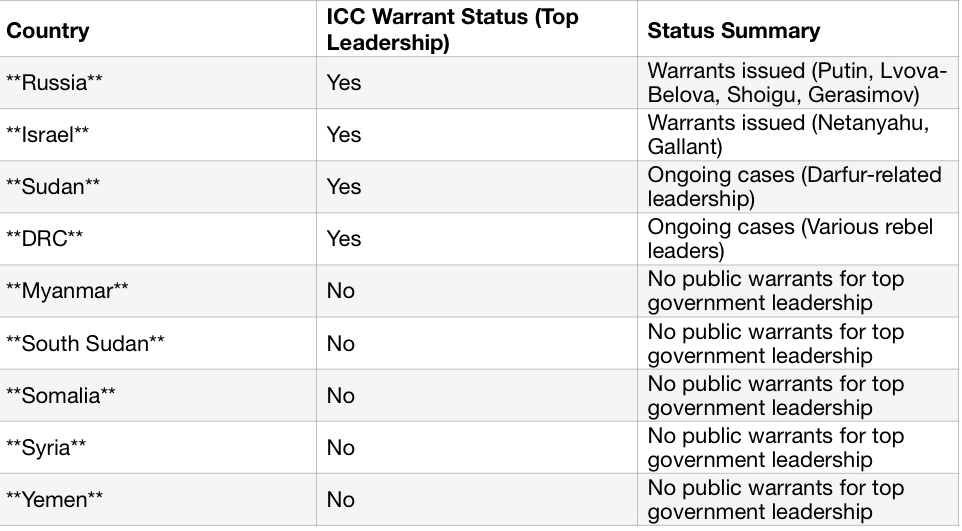
What links these disparate cases?
Often, it is the breakdown of the internal social contract. When a state can no longer provide for its citizens, when it relies on repression to maintain order, or when its institutions are hollowed out by mismanagement, it becomes vulnerable—not just to economic collapse, but to the harsh gaze of the international community.
A Note on Context
It is important to distinguish between the systemic fragility of a developing nation and the geopolitical friction of major powers. Russia and Israel are not "fragile" in the way a nation struggling with basic fiscal solvency is. Their presence on the ICC list is not a sign of institutional collapse, but rather a reflection of high-stakes international conflict and the intense, polarising nature of the decisions their leadership has made.
In contrast, for a country like Madagascar, the danger is not that we will become a global geopolitical player, but that we will become a failed state—hollowed out from within by fiscal mismanagement and a breakdown of the social contract.
The Anatomy of Fragility
When we look at countries that slide into crisis, we aren't just looking at bad luck. We are looking at specific, systemic fractures. In the context of our own situation, we can identify three "fragility areas" that act as the fault lines for stability:
* Institutional Erosion: When the basic machinery of state—tax collection, civil service payrolls, and judicial independence—begins to fail, the state loses its ability to protect its citizens.
* The Fiscal Dead-End: When a government cannot balance its budget, it becomes beholden to external creditors or resorts to predatory domestic revenue practices. This fiscal desperation is often the precursor to political instability.
* The Breakdown of the Social Contract: When the state shifts from a service provider to a security apparatus, the trust between the government and the governed vanishes. As we are seeing in Antananarivo, the moment that trust is replaced by fear, the state's grip on order becomes increasingly precarious.
Madagascar: The Luxury of Neutrality
Here in Antananarivo, the atmosphere is heavy. Recent disappearances and the palpable sense of fear remind us that stability is fragile. Yet, Madagascar’s foreign policy remains, by and large, one of cautious neutrality.
Some might call this indecisive, but I see it as a survival strategy. For a nation grappling with severe economic constraints, "geopolitical alignment" is a luxury that can be bought only with the currency of a stable, functioning state. When you are struggling to keep the lights on and the schools open, you cannot afford to be an international pariah. Neutrality is the shield that buys time.
The Reality of Power
There is a hard truth at the heart of geopolitics: power is everything. For the world’s most powerful nations, the rules are often treated as suggestions. For the rest—for nations like Madagascar—the goal is not to shape the global order, but to avoid being crushed by it.
The path forward for a fragile state isn't found in grand international posturing or choosing sides in distant conflicts. It is found in the slow, grinding, and essential work of fixing the foundations: tax reform that actually works, a ruthless commitment to rooting out corruption, and ensuring the state exists to serve its people, not to repress them.
If we want to avoid the fate of those on the international "watch list," Madagascar must recognise that the most important battles aren't being fought in the halls of the ICC or the UN. They are being fought right here, in the daily struggle to build a government that is honest, transparent, and capable of functioning for the people it represents.


Comments
Post a Comment