The Choice Ahead: Agency, Control, or the Illusion of Both
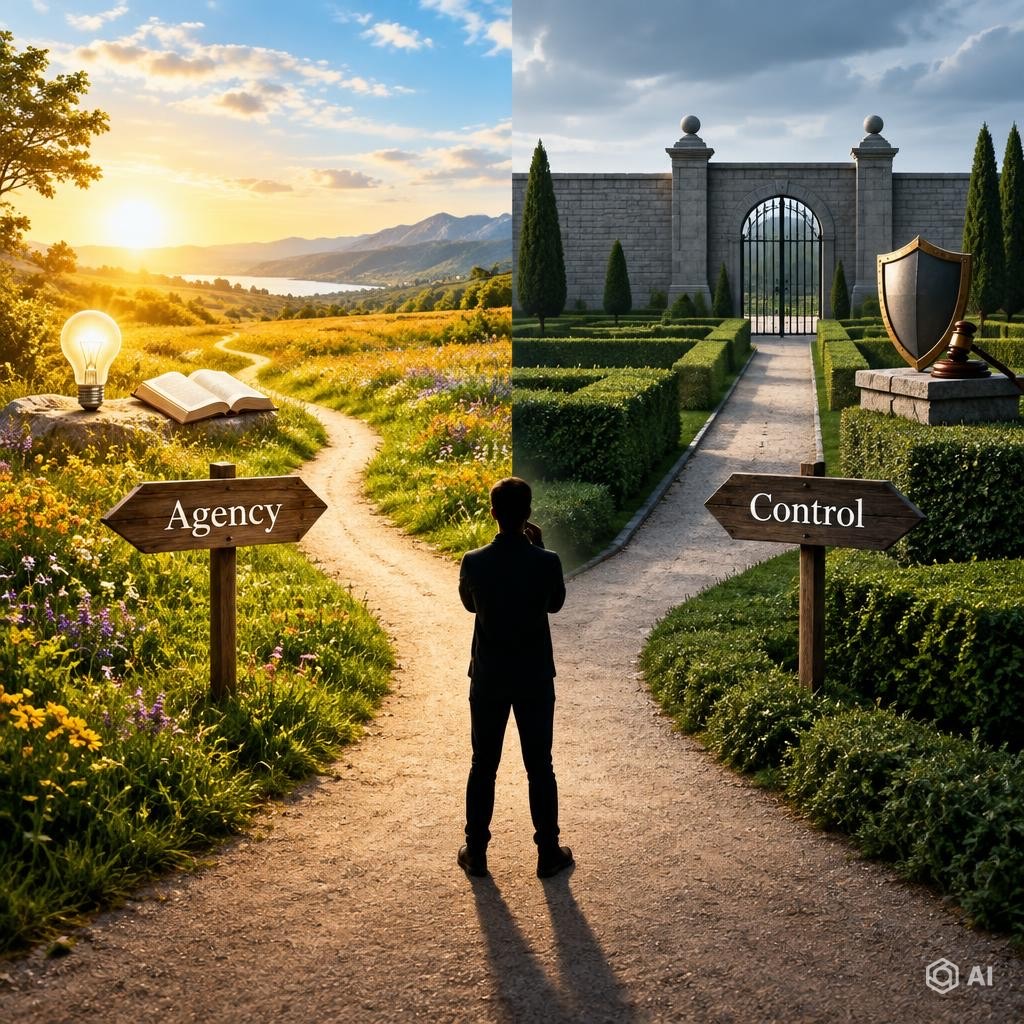
We began this series by proposing a simple, universal metric for understanding politics: the tension between Agency (the power of the individual to act) and Control (the power of the state to direct).
We have traveled across the spectrum:
* We saw Liberal Democracy as the "Agency-First" model, designed to protect the individual from the state, even at the cost of efficiency.
* We examined Burkina Faso as a "Sovereignty Pivot," where a population trades individual agency for the perceived security and strength of a centralized national mission.
* We explored Madagascar as a "Hybrid Reality," where a façade of democratic agency masks a structural system of informal control and patronage.
Now, as we conclude, we are left with a final, uncomfortable question: What are we actually choosing?
The Danger of the Illusion
The most dangerous political system isn't necessarily the one that demands your submission; it is the one that lies to you about your power.
When a state openly demands control, you know where you stand. You know you are being asked to sacrifice your agency for the state’s goals. But when a system—like the hybrid model we see in Madagascar—promises you agency while quietly siphoning it away through patronage and bureaucratic "noise," it creates a state of perpetual frustration. It keeps citizens in a loop of waiting for reforms that never arrive, all while maintaining the appearance of a free society.
The Responsibility of the Individual
If we accept that Agency is the engine of innovation, dignity, and real structural progress, then the burden of proof is on us.
* In a Democracy: The challenge is to ensure that "Agency" doesn't become "Apathy"—that we don't take our rights for granted until they are eroded.
* In a Transitional State: The challenge is to ensure that the "Sovereignty" gained is actually used to build a foundation for future agency, rather than just entrenching a new elite.
* In a Hybrid System: The challenge is to see through the façade. It requires "structural honesty"—calling out the difference between the laws on paper and the reality of the street.
A Final Thought
The political systems we live under are not just "happening" to us; they are the result of the trade-offs we, as a society, are willing to make.
Whether you are in a system that prioritizes control or one that claims to prioritize agency, the most important thing you can do is to measure the reality against the rhetoric. Are you being empowered to build, or are you being managed to submit?
The future of any nation isn't found in its political labels. It is found in the extent to which its people are willing to demand, protect, and exercise their own agency.
Thank you for joining me on this deep dive. I hope this framework helps you navigate the noise of our political world with a bit more clarity.


Comments
Post a Comment