Breaking the Pyramid of Corruption: Leadership, Justice and Madagascar’s Reform Challenge - Part One: Corruption as a System
Part One: Corruption as a System
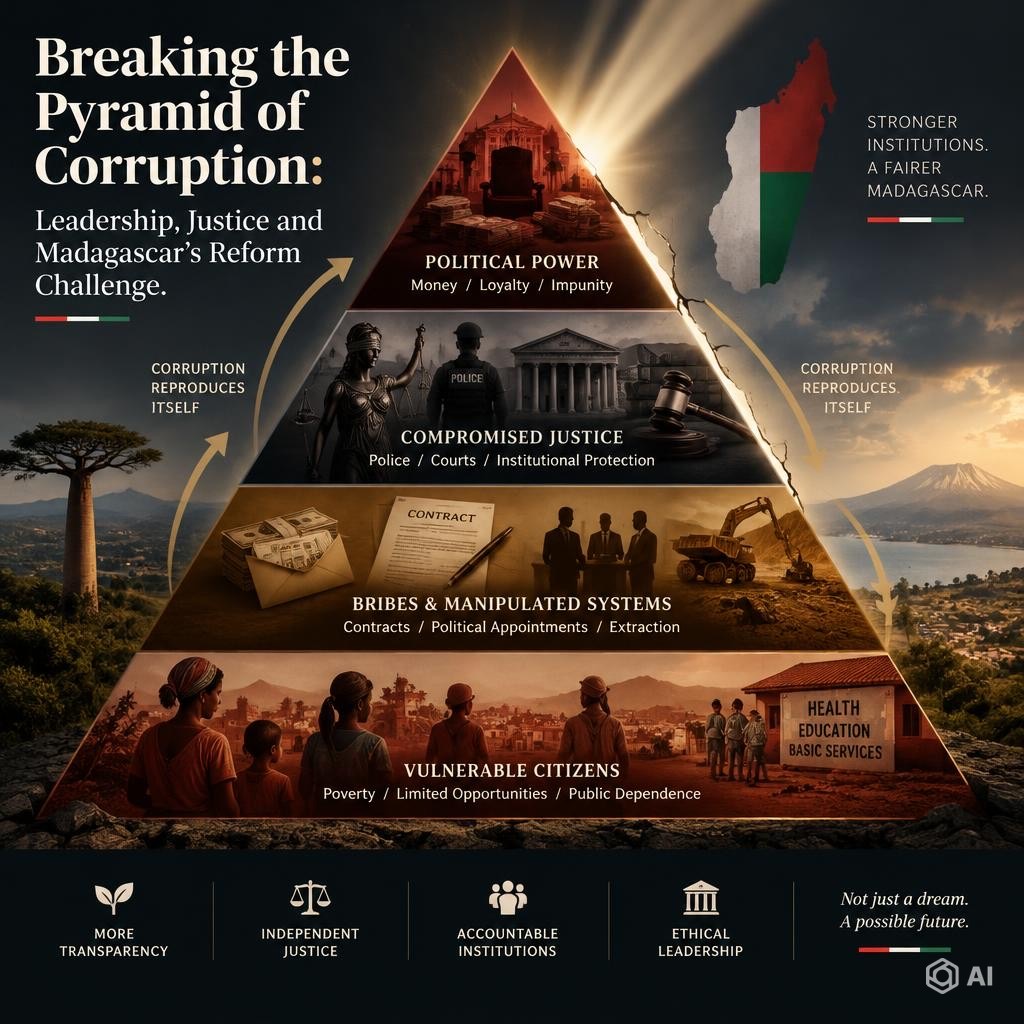
Corruption is often described as the behaviour of dishonest individuals: an official accepting a bribe, a politician misusing public money or a judge abusing their authority.
These actions matter, but they do not fully explain how corruption survives.
Corruption becomes most damaging when individual acts form part of a wider system—one linking political power, public appointments, money, business interests, weak justice and social dependence.
The central question is therefore not only:
Who takes the bribe?
It is also:
Who benefits from the system, and who protects it?
From individual misconduct to organised dependence
In a weak institutional environment, ordinary citizens may depend on officials, politicians, intermediaries or lenders to obtain basic opportunities and services.
They may need assistance to:
- obtain identity documents;
- access healthcare or education;
- secure employment;
- obtain a licence or permit;
- resolve a legal dispute;
- receive public benefits;
- protect a family member from arbitrary treatment.
When access depends on personal connections or informal payments, citizens are no longer equal before the state. They become dependent on those who control access.
This dependence creates an environment in which corruption can grow.
A person may pay a small bribe to obtain a service. A business may pay for a contract. A political supporter may receive a public appointment. A senior official may be protected from investigation because they are useful to a powerful patron.
These actions appear different, but they may form part of the same structure.
The pyramid of corruption
The system can be understood as a pyramid with several connected levels.
The base: public dependence
At the base are citizens who depend on public officials, political intermediaries or private lenders for access to essential opportunities.
Poverty makes this dependence more severe. A person who cannot afford legal assistance, transport, medical care or a period without income is more vulnerable to pressure.
Economic insecurity therefore does not merely create hardship. It can reduce a person’s ability to resist corruption.
The middle: extraction and exchange
In the middle of the pyramid, officials and intermediaries exchange access for money, loyalty or influence.
This may involve:
- bribes;
- manipulated contracts;
- inflated prices;
- public jobs given to supporters;
- licences issued selectively;
- political protection;
- misuse of state resources;
- pressure on businesses or vulnerable families.
The public office is no longer treated as a responsibility held on behalf of citizens. It becomes a source of private advantage.
The upper levels: protection
At higher levels, political patrons protect officials, businesspeople and allies from consequences.
Investigations may be delayed. Complaints may disappear. Witnesses may be intimidated. Prosecutors may be pressured. Courts may be influenced. Officials may be transferred rather than disciplined.
When people believe that powerful individuals are untouchable, the law loses its authority.
The apex: political survival
At the apex, corruption can become part of political survival.
Money may be used to finance campaigns. Public appointments may reward loyalty. Contracts may strengthen political alliances. Control over institutions may prevent rivals from challenging the system.
In return, supporters may receive access, influence, employment, contracts or immunity.
Corruption then becomes more than personal enrichment. It becomes a method of organising power.
Public office as an investment
One of the most important features of this system is the treatment of public office as an investment.
A position may be secured through:
- money;
- political loyalty;
- family connections;
- campaign support;
- factional allegiance;
- personal relationships.
If an appointment has been obtained through payment or patronage, the officeholder may feel pressure to recover that investment.
This can produce a dangerous cycle:
1. A person pays for influence or an appointment.
2. The position provides access to public decisions and resources.
3. Bribes or favours are used to recover the original investment.
4. Some of the proceeds are passed upward to political or institutional protectors.
5. The officeholder is shielded from accountability.
The position is no longer regarded primarily as a public duty. It becomes a private asset.
This is a structural risk, not an accusation against every official. Many public servants act with integrity despite difficult conditions. But where appointments are not transparent and institutions are weak, the danger of this investment model becomes much greater.
The justice system as a protective layer
The justice system is central to whether the pyramid survives.
If police, prosecutors and courts operate independently, corruption becomes more dangerous for those who participate in it. If they are politically controlled or financially compromised, the justice system may become part of the protection network.
A judge, prosecutor or police officer who depends on political favour may hesitate to investigate powerful people. A person who has invested heavily to obtain office may use that position to collect bribes or protect those who helped them.
The result is a reversal of the purpose of justice.
Instead of protecting citizens from power, the system protects power from citizens.
This is why judicial independence is not an abstract constitutional principle. It is a practical defence against corruption, intimidation and arbitrary rule.
Not unique to Madagascar
Madagascar’s challenges are serious, but they are not unique.
Other countries have faced combinations of patronage, purchased influence, weak courts, political intimidation and public dependence. Some have made significant progress, while others have struggled because reforms were selective, temporary or controlled by the same networks they were supposed to dismantle.
International examples matter because they demonstrate two things:
- corruption is not an unavoidable feature of national character;
- reform requires more than changing laws or replacing individual officials.
Countries that have improved have generally combined political leadership with stronger institutions, more transparent appointments, better procurement systems, independent oversight and protection for those who expose wrongdoing.
The most important test is whether leaders allow investigations to reach their own supporters.
A government that prosecutes only its political opponents may be conducting a power struggle, not an anti-corruption campaign.
The central challenge
The real challenge is not simply to remove corrupt individuals. It is to dismantle the relationships that allow corruption to reproduce itself.
That means asking:
- Who controls public appointments?
- Who benefits from government contracts?
- Who protects officials from investigation?
- Who finances political influence?
- Who is excluded when services depend on personal connections?
- Can journalists, citizens and civil society investigate without intimidation?
- Can courts hold powerful people accountable?
- Will reforms survive a change of government?
Until these questions are addressed, corruption will continue to regenerate.
The Pyramid of Coercion shows how fear, poverty and dependence control citizens.
The Pyramid of Corruption shows how money, influence and legal protection preserve the system that creates that dependence.
Breaking one pyramid requires confronting the other.
Part Two will examine the historical and political conditions that allow systems of patronage to develop and survive.


Comments
Post a Comment