Breaking the Pyramid of Corruption: Leadership, Justice and Madagascar’s Reform Challenge Part Two: How Patronage Systems Develop and Survive
Part Two: How Patronage Systems Develop and Survive
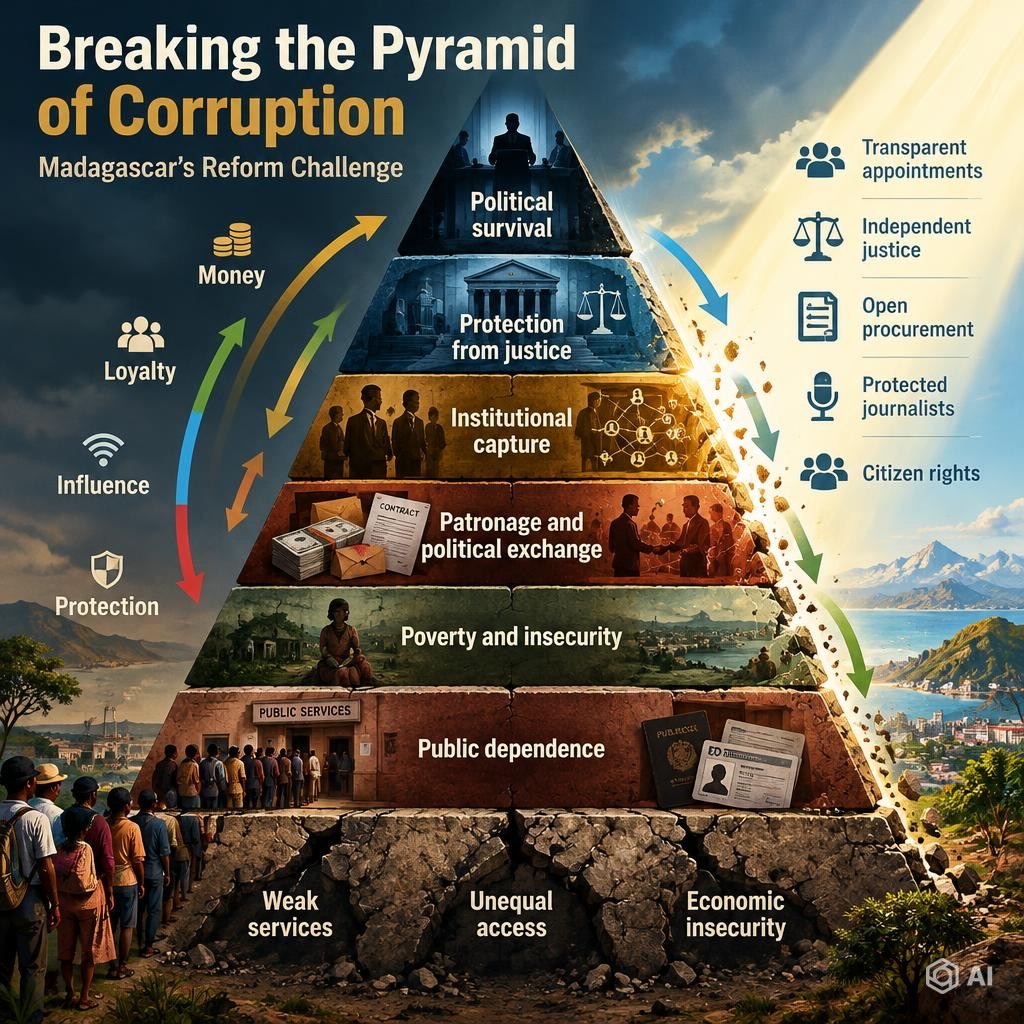
Corruption does not appear overnight.
It develops gradually when political institutions are weak, public resources are scarce, accountability is selective and citizens depend on personal relationships to obtain what should be available as a right.
Over time, these conditions can create a system of patronage: a network in which power, loyalty, money and protection are exchanged.
Understanding this process is essential. If corruption is treated only as the result of individual dishonesty, reform will remain superficial. If it is understood as a political and institutional system, the deeper causes become easier to identify.
The historical inheritance
Madagascar’s modern state developed through periods of colonial rule, independence, political instability, economic crisis and institutional change.
Each period left its own legacy.
Colonial administration created centralised systems of authority in which decisions were often made far from local communities. After independence, the new state had to extend public services across a large and geographically difficult country with limited resources.
This created a lasting tension.
Citizens expected the state to provide education, healthcare, justice, infrastructure and administration. Yet the state often lacked the money, personnel and institutional capacity to meet those expectations consistently.
When formal institutions cannot deliver, informal systems begin to fill the gap.
People turn to relatives, local leaders, political intermediaries, business contacts or officials who can help them navigate the system. These relationships may begin as practical forms of assistance. But they can gradually become systems of obligation and dependence.
When the state is present but inaccessible
A weak state is not necessarily an absent state.
In many cases, public institutions exist, but access to them is unequal, slow or unpredictable. Offices operate, but citizens may not know how to use them. Laws exist, but enforcement may vary. Services are officially available, but obtaining them may require money, connections or persistence that poorer citizens do not possess.
This creates a gap between formal rights and practical access.
A person may technically have the right to:
- obtain an identity document;
- register a business;
- receive education;
- access medical treatment;
- report a crime;
- receive justice;
- obtain public employment.
But if the process is too costly, too slow or too dependent on personal influence, the right becomes difficult to exercise.
The citizen is then pushed towards intermediaries.
Those intermediaries may provide useful assistance, but they may also demand payment, loyalty or political support in return. A public service becomes a personal favour. A legal right becomes a negotiated privilege.
The rise of patronage
Patronage develops when access to resources depends on personal loyalty rather than universal rules.
A patron may be a politician, senior official, businessperson, local powerbroker or influential intermediary. The patron provides access to employment, contracts, protection or services.
The client provides loyalty, votes, money, labour, information or political support.
This exchange can occur at many levels.
A national political figure may appoint supporters to important positions. A local official may favour relatives or political allies. A businessperson may support a candidate in expectation of future contracts. A citizen may join a political network because it offers the only realistic route to employment or protection.
The relationship is rarely equal.
The patron controls resources. The client depends on the patron. This imbalance makes it difficult for the client to refuse demands or report wrongdoing.
Patronage therefore creates more than political loyalty. It creates vulnerability.
Political instability and institutional weakness
Political instability can deepen these relationships.
When governments change frequently, institutions may become focused on survival rather than long-term development. Officials may fear that a change of government will cost them their position. Political leaders may replace experienced personnel with loyal supporters. Civil servants may learn that political protection is more important than professional independence.
This produces a culture of insecurity.
If people believe that their employment, contracts or protection depend on remaining close to the current political leadership, they have an incentive to serve individuals rather than institutions.
The result is a cycle:
1. Political leaders appoint loyal supporters.
2. Officials become dependent on political protection.
3. Public resources are used to reward supporters.
4. Institutions lose independence.
5. Citizens seek personal connections to obtain access.
6. Political leaders gain even greater control over society.
The system becomes self-reinforcing.
Elections and the competition for resources
Elections can also strengthen patronage when political competition is expensive and institutions are weak.
Candidates need money, supporters, transport, communication networks and political organisation. When public financing is limited or political donations are not transparent, candidates may depend on wealthy individuals, businesses or informal networks.
Those who finance political campaigns may later expect influence, contracts, appointments or favourable treatment.
This does not mean that every political donation is corrupt. Political parties require legitimate support, and citizens have the right to participate in public life.
The danger arises when political finance is hidden and public decisions are used to repay private obligations.
A contract may be awarded not because a company offers the best service, but because it supported a political network. A public appointment may be made not because a candidate is qualified, but because they are loyal.
The state then becomes a mechanism for rewarding political investment.
Poverty and the price of independence
Poverty makes resistance more difficult.
A person with savings may be able to refuse an illegal demand, wait for a formal process or seek legal assistance. A person living from one day to the next may not have the same choices.
If refusing a bribe means losing access to treatment, employment, documentation or a public benefit, the citizen may feel compelled to comply.
This is why corruption should not be understood simply as a moral failure by those who pay.
Some people actively exploit the system. Others participate because the system leaves them with no safe alternative.
Economic insecurity can also make public employees vulnerable. Poorly paid officials may be pressured by senior colleagues, political patrons or local business interests. Low salaries do not justify corruption, but they can increase the temptation and reduce the ability to resist it.
Reform must therefore address both accountability and material conditions.
Natural resources, land and strategic access
Where resources are scarce or valuable, political control becomes more important.
Land, mining, public contracts, customs, infrastructure projects and access to markets can create powerful incentives for political influence. Businesses may seek privileged access, while politicians may use control over permits and public decisions to strengthen their networks.
The problem is not the existence of private business or investment. Economic development requires both.
The problem arises when competition is replaced by political favour.
If companies believe that success depends more on connections than productivity, honest businesses are discouraged. Smaller enterprises remain informal. Investors seek protection rather than transparency. Citizens lose confidence that effort and ability will be rewarded fairly.
This weakens the economy and strengthens the political networks that control access to opportunity.
Why institutions become captured
Institutional capture occurs when public bodies continue to exist formally but serve private or political interests in practice.
A ministry may have laws, procedures and professional staff, yet decisions may still be directed by informal instructions. A court may be legally independent, but judges may fear political consequences. An anti-corruption body may have investigative powers, but lack the resources or authority to pursue powerful figures.
Capture does not always require direct orders.
It may operate through appointments, budget control, transfers, promotions, threats or the expectation of future reward. Officials learn what is permitted and what is dangerous. They may censor themselves before anyone needs to intervene.
This is how institutions can become obedient without appearing openly controlled.
The role of social relationships
Madagascar is a society in which family, community and personal relationships are important sources of support. These relationships can protect people from hardship and strengthen social solidarity.
They should not automatically be confused with corruption.
Helping a relative find employment, supporting a neighbour or recommending a competent person is not necessarily wrong. The ethical problem arises when personal relationships override public duty, exclude qualified candidates or involve the misuse of public resources.
The distinction is important.
A society cannot function without trust and cooperation. But public institutions cannot become private extensions of family or political networks.
When every decision is judged by personal loyalty, citizens are forced to compete through connections rather than rights.
Reform controlled from above
One of the greatest dangers is reform that is announced but not enforced.
Governments may introduce new laws, create commissions, publish strategies or make public declarations against corruption. These measures may appear impressive but achieve little if the underlying networks remain untouched.
Reform can even be used politically.
A government may investigate opponents while protecting supporters. A new institution may be created to demonstrate commitment, while its independence is quietly restricted. A few individuals may be prosecuted to create the appearance of action, while the wider system continues unchanged.
This is why the credibility of reform depends on consistency.
The public must see that investigations can reach people close to power, that evidence is treated seriously and that legal consequences do not depend on political affiliation.
Leadership as a test of reform
Political leadership is important, but leadership alone is not enough.
A determined leader can begin reforms, remove obstructive officials and support stronger institutions. However, if the system depends on personal authority, progress may disappear when that leader leaves office.
The real objective must be to replace personal control with institutional accountability.
A reform-minded government should therefore be judged by questions such as:
- Are public appointments transparent?
- Are qualifications more important than political loyalty?
- Are public contracts openly competitive?
- Can investigators act without political interference?
- Are whistleblowers protected?
- Can journalists investigate powerful people safely?
- Are courts able to rule against the government?
- Are public finances accessible to citizens?
- Are officials disciplined consistently?
- Can reforms survive a change of leadership?
These questions move the discussion away from political promises and towards measurable behaviour.
Breaking the historical cycle
Madagascar cannot reform its institutions by pretending that history does not matter.
Political instability, poverty, centralisation, weak administration and unequal access have all contributed to the growth of patronage. But history is not destiny.
The same institutions that have been used to distribute favours can be redesigned to protect rights. Public appointments can become competitive. Procurement can become transparent. Courts can become more independent. Local administrations can become more accessible. Citizens can be given greater protection when they challenge abuse.
The first step is to recognise the system honestly.
Corruption survives when it is treated as a collection of isolated scandals. It becomes harder to sustain when citizens understand the connections between political finance, public appointments, economic dependence, legal protection and institutional weakness.
The pyramid was built over time.
It will not be dismantled by one speech, one law or one prosecution. It will require sustained leadership, independent institutions and citizens who are able to claim their rights without needing permission from political patrons.
Part Three will examine the role of leadership, political will and the justice system in determining whether reform becomes genuine change or another layer of protection for the existing system.


Comments
Post a Comment