From Promises to Results: What Will the Madagascar–Russia Partnership Deliver?
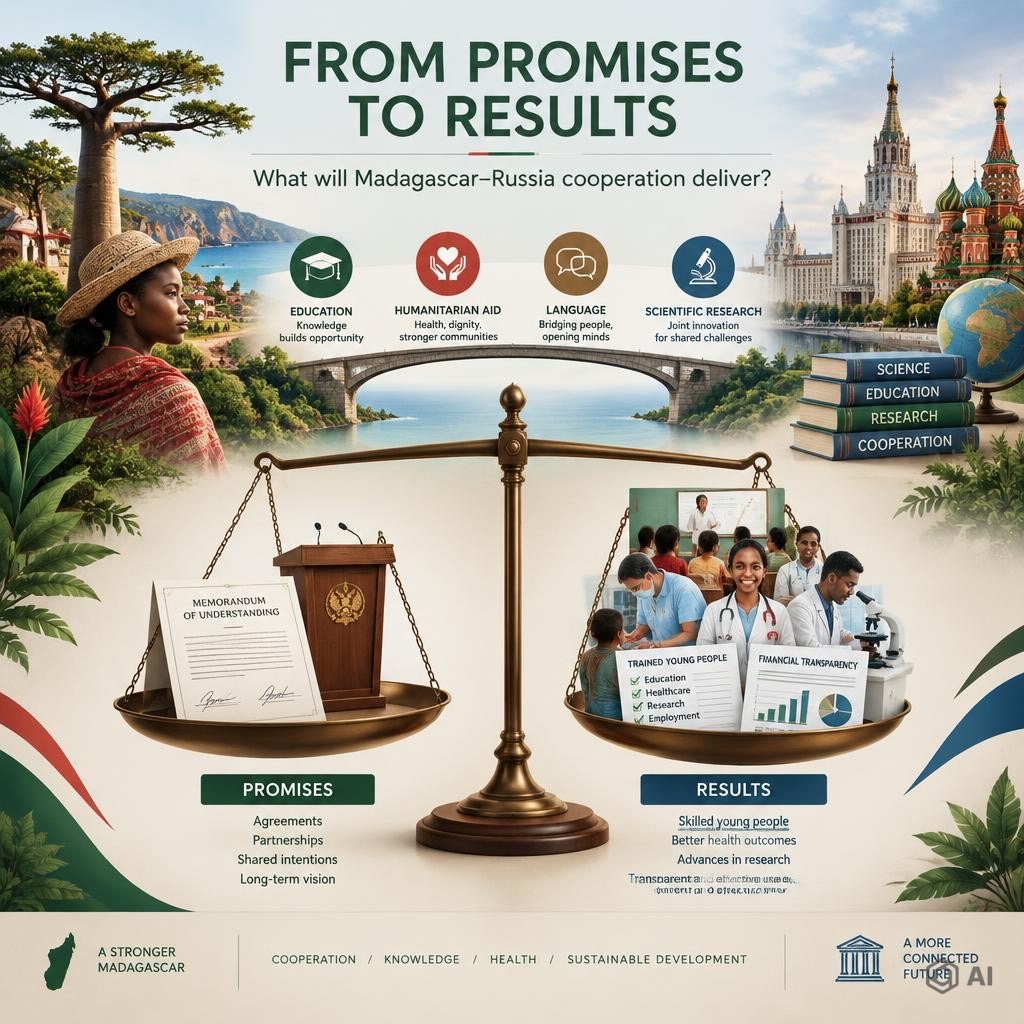
The proposed cooperation between Madagascar and Russia has been presented as an opportunity to promote Russian language and culture, expand humanitarian assistance, and support education, youth training and scientific research.
These objectives could bring real benefits to the Malagasy population. Better access to education, professional training and humanitarian support should be welcomed. But a memorandum of understanding is not the same as a completed project, and presidential statements are not tangible results.
The central question is simple:
What will ordinary Malagasy citizens actually receive from this partnership?
From announcements to implementation
The proposed cooperation reportedly includes Russian-language programmes, cultural centres, university exchanges, youth training and scientific collaboration. There has also been discussion of up to US$10 million in funding.
However, the public needs clarity:
- Has the funding been formally committed?
- Who will administer it?
- Which schools, universities or communities will benefit?
- How many students will receive training or scholarships?
- When will the programmes begin?
- Will independent audits be published?
Without clear answers, the initiative remains a political promise rather than a development programme.
Education or influence?
Cultural and language programmes can provide useful opportunities. Malagasy students may gain access to new skills, international networks and academic exchanges.
But cultural cooperation can also serve as an instrument of political influence. Promoting another country’s language and culture is not automatically propaganda, but the risk increases if programmes are politically controlled, one-sided or presented as humanitarian assistance without transparency.
The curriculum should therefore be educationally balanced, opportunities should be open and fairly allocated, and independent Malagasy institutions should participate in oversight.
What would success look like?
The partnership should be judged by measurable outcomes:
- Students trained and qualifications achieved.
- Teachers and language instructors recruited.
- Scholarships and university exchanges completed.
- Research projects published.
- Humanitarian assistance delivered to identifiable communities.
- Funds independently audited.
- Long-term employment or educational benefits created.
A public scorecard could allow citizens to compare each promise with the evidence of delivery.
Madagascar needs results
Madagascar has no shortage of announcements, ceremonies and memoranda. Its shortage is reliable implementation.
The President’s words may express a genuine desire for international cooperation, but the population needs more than speeches. It needs functioning schools, trained young people, improved services, accountable institutions and visible humanitarian assistance.
Madagascar should welcome cooperation that serves its national interests. But every agreement should be tested against three principles:
Transparency. Accountability. Results.
The success of this partnership will not be measured by the ceremony at which it was signed. It will be measured by what reaches Malagasy classrooms, laboratories and communities.


Comments
Post a Comment