Madagascar’s Banking and Credit Laws
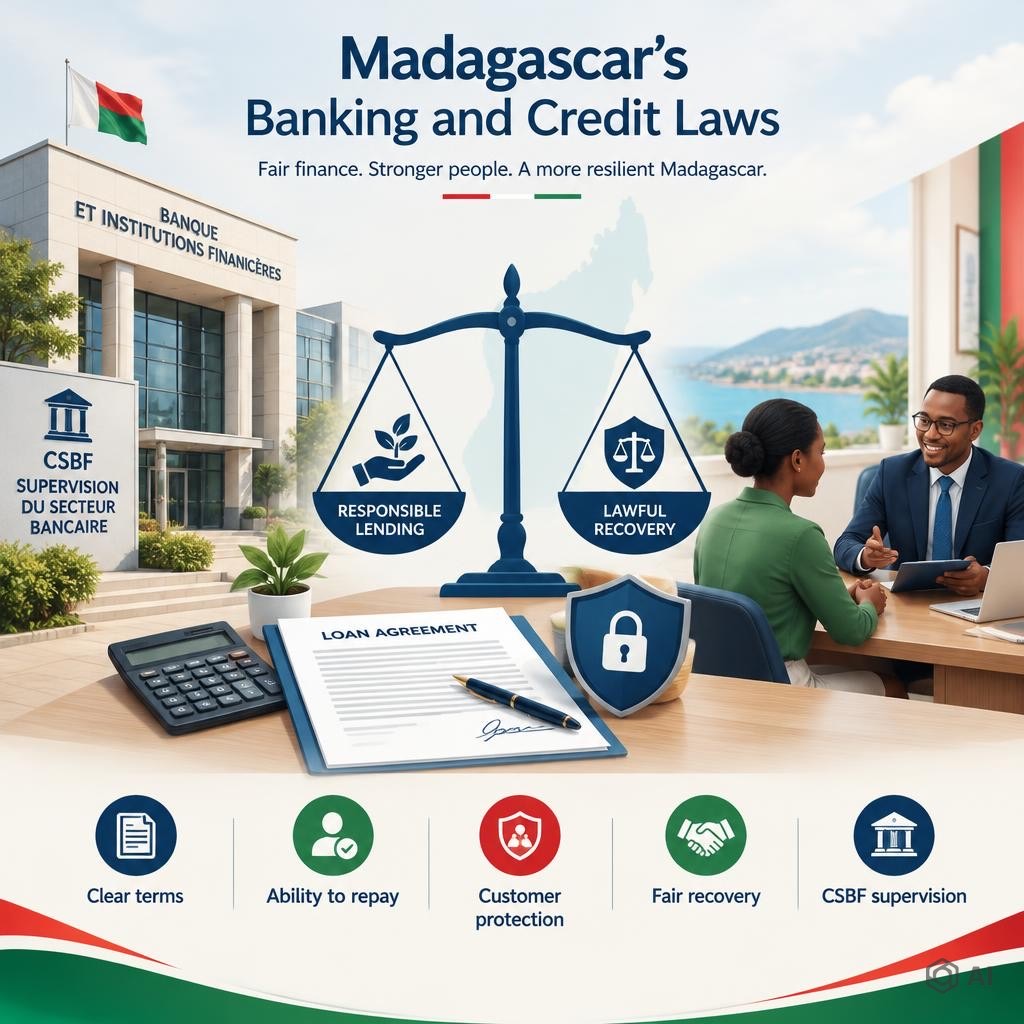
Madagascar’s Banking and Credit Laws
Madagascar’s banking and credit system is governed mainly by Law No. 2020-011 of 1 September 2020, which regulates credit institutions, banking services, supervision and customer protection.
Main customer protections
A credit agreement should clearly state:
- the loan amount;
- interest rates and fees;
- repayment dates and conditions;
- early-repayment rights;
- withdrawal rights, where applicable;
- debt-recovery procedures;
- the bank’s complaints process.
Banks are also expected to assess a borrower’s ability to repay before granting credit and to protect customers’ confidential and personal information.
Violations of certain consumer-protection provisions may result in fines.
Debt recovery
Madagascar does not appear to have one comprehensive code governing every aspect of debt collection. Recovery generally depends on:
- the loan agreement;
- guarantees or collateral;
- civil-procedure rules;
- secured-transactions law;
- consumer-protection requirements;
- data-protection rules.
A bank may recover a legitimate debt, but this does not give it permission to threaten, harass or humiliate customers.
Banking supervision
The Commission de Supervision Bancaire et Financière (CSBF) is responsible for licensing, supervising and, where necessary, sanctioning financial institutions. It also has responsibilities relating to consumer protection and financial stability.
Customers should normally complain to the bank first and keep copies of contracts, statements, correspondence and payment records. If the matter is unresolved, they may consider approaching the CSBF or the courts.
Other relevant laws
The wider credit system also involves laws relating to:
- secured lending and collateral;
- leasing and credit agreements;
- microfinance;
- personal-data protection;
- electronic transactions and signatures;
- foreign exchange;
- money laundering.
Reforms that may be needed
Madagascar could strengthen the system by introducing or improving:
1. A clear debt-collection code prohibiting threats, harassment and public humiliation.
2. Independent financial ombudsman services for customers who cannot resolve disputes with banks.
3. Transparent interest and penalty limits, with all charges clearly explained before signing.
4. Mandatory hardship procedures, including restructuring and reasonable repayment plans.
5. Better supervision of microfinance and informal lenders.
6. Stronger enforcement powers for the CSBF.
7. Accessible legal assistance for vulnerable borrowers.
8. A reliable credit-information system that protects privacy and prevents inaccurate blacklisting.
9. Financial education so customers understand interest, collateral, penalties and default procedures.
10. Protection against abusive enforcement, while still allowing banks to recover legitimate debts.
The aim should not be to prevent banks from managing risk. Banks will inevitably experience defaults. The aim is to ensure that debt recovery is lawful, transparent, proportionate and humane.
Responsible lending requires responsible debt recovery.


Comments
Post a Comment