The Architecture of Silence: Who Controls the News in Madagascar?
In our last post, we saw how the "Global Chill" is creating a permissive environment for the suppression of press freedom. Now, we turn our gaze to the reality here in Madagascar. We have to ask: How is the information landscape actually controlled?
If you look at the media landscape in Madagascar, it appears pluralistic on the surface. We have radio stations, TV channels, and newspapers. But if you look closer, you see a system designed to ensure that the "Agency" of the public is kept in check.
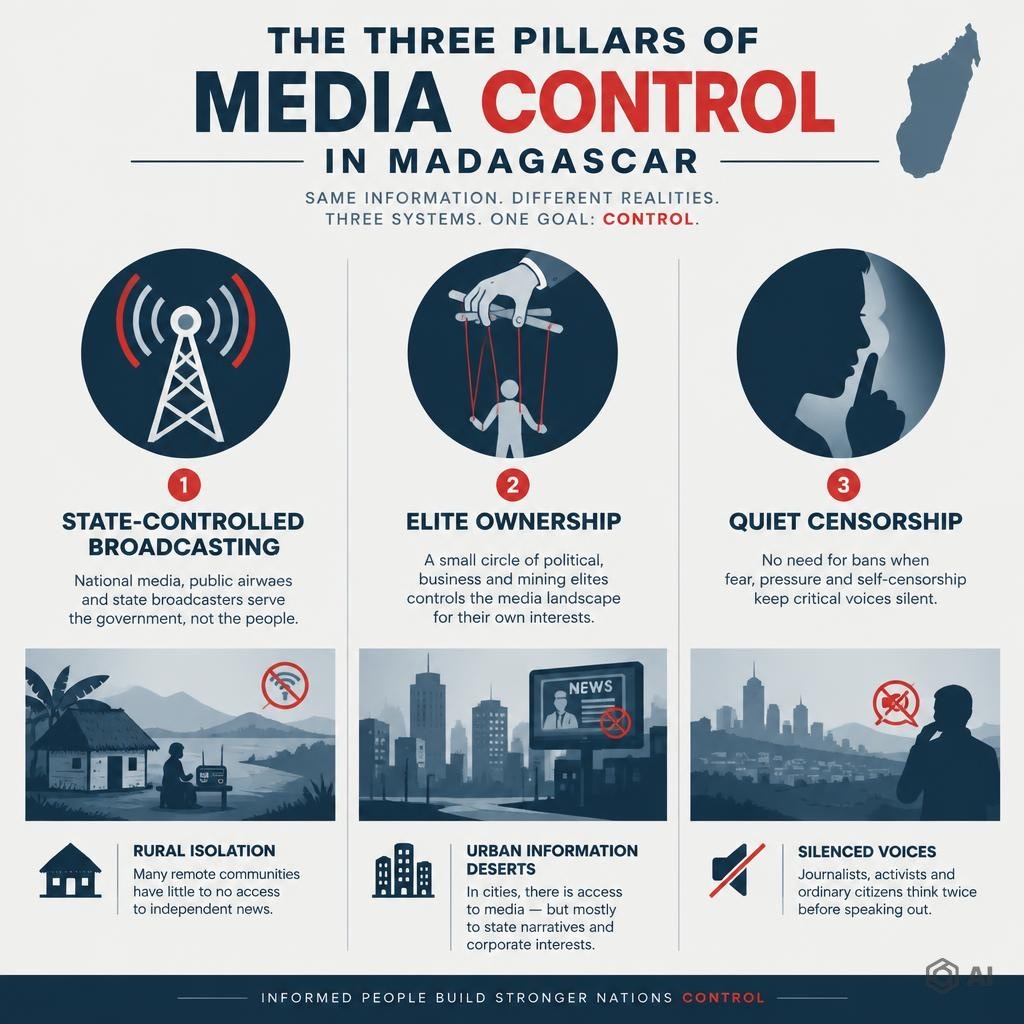
The Three Pillars of Control
1. State-Controlled Broadcasting: Public broadcasters like RNM and TVM are the "voice of the state." They don't just report the news; they follow government communication directives. Because they have the broadest national reach, they are the primary tool for shaping the national narrative, especially in rural areas where access to other sources is limited.
2. The "Elite" Ownership Model: Much of the private media landscape is not truly independent. Many outlets are owned or heavily influenced by ministers, parliamentarians, or business elites with deep ties to the political establishment. When your boss is a politician, your editorial independence is the first casualty. The news doesn't have to be "banned"—it just has to be "filtered" through the interests of the owner.
3. The "Quiet" Censorship: In Madagascar, the government rarely needs to resort to overt bans or arrests. Instead, they use the legal system as a tool. Broad powers to suspend licenses, seize equipment, or impose heavy fines create an environment where journalists don't need to be told what not to say—they already know. This is the ultimate form of Control: self-censorship.
The Rural Divide: The Information Desert
We must also address the geography of the silence. In Antananarivo, there is at least the possibility of finding independent information. But in rural Madagascar, the situation is an "information desert."
With weak telecom infrastructure, high poverty, and limited access to the written press, rural citizens are often forced to rely on whatever signal reaches them—which is almost exclusively state-controlled radio or TV. This creates a two-tiered society: those who have access to information, and those who are kept in a state of controlled ignorance.
Why This Matters
When the media is controlled by elites, owned by politicians, and constrained by the threat of legal action, the "Social Contract" we discussed earlier breaks down. You cannot have an informed citizenry if the information they receive is curated to protect the very people they should be holding accountable.
This isn't just about "bad news." It’s about the fact that without an independent press, the structural issues we’ve been discussing—the budget deficits, the tax failures, the lack of basic services—are never truly debated. They are hidden behind a wall of state-approved noise.
The Question for Us
As we continue this series on Freedom of Speech, we need to ask: Who is our media actually serving?
Are we getting the information we need to exercise our agency, or are we being fed a curated reality designed to keep us passive? The first step toward reclaiming our agency is recognising the wall that has been built around our information.


Comments
Post a Comment