The Daily Tug-of-War: Where Agency Meets Control
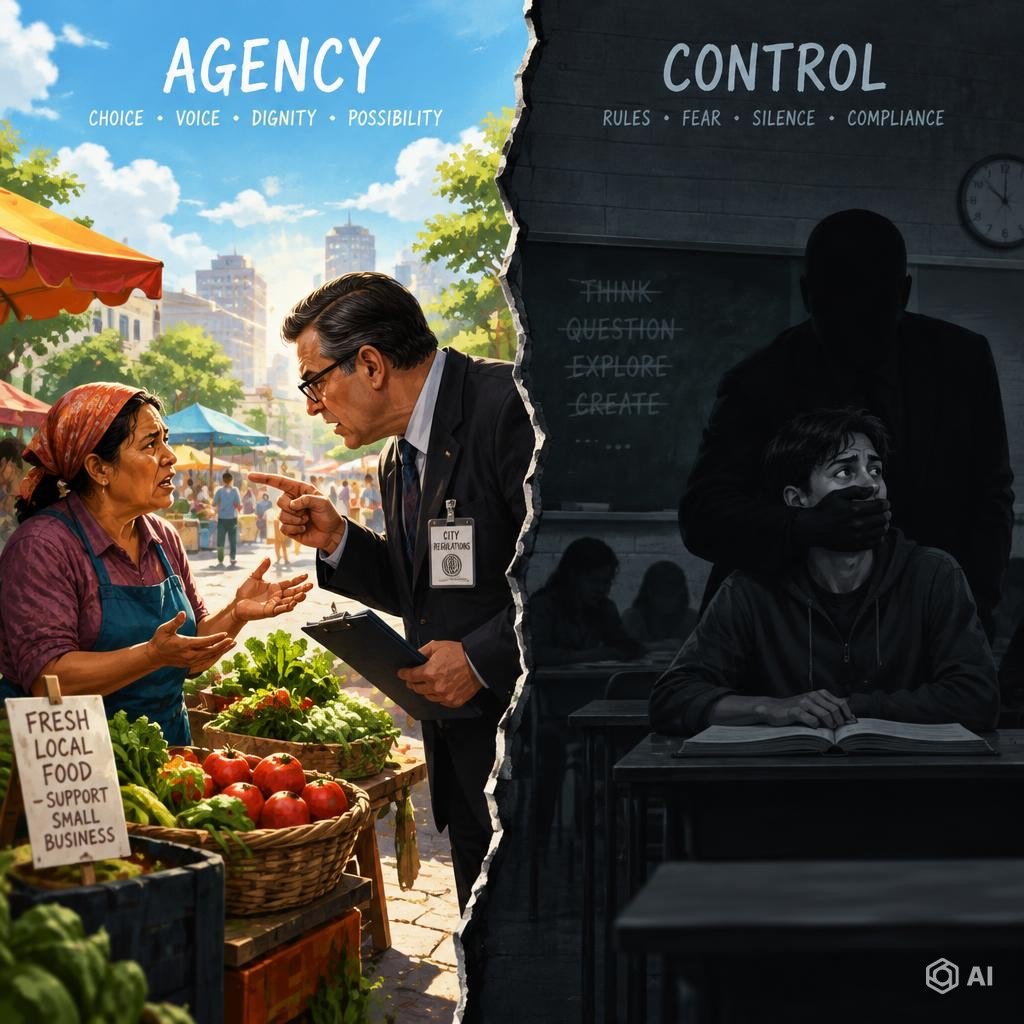
We have spent the last few days exploring the "Agency vs. Control" framework at a national level. But the truth is, this tension doesn't just exist in parliaments or presidential palaces. It happens in the streets, the classrooms, and the markets every single day.
If you want to know which system you are living in, you don't look at the Constitution. You look at the daily friction of your life.
1. The Market Stall (Economic Agency)
* The Agency View: A vendor has the right to set up, buy goods, and trade without fear of arbitrary seizure. The state provides the infrastructure (roads, security) and stays out of the way.
* The Control View: The vendor is harassed for permits, forced to pay "informal taxes" to local officials, or restricted by monopolies. Here, the state is not a partner; it is a predator.
2. The Classroom (Intellectual Agency)
* The Agency View: Students are encouraged to ask "Why?" and taught that their ideas have value.
* The Control View: Students are taught to memorize and repeat. They are warned that asking the wrong question can lead to trouble for their families. They learn that the safest path is silence.
3. The Digital Space (Communication Agency)
* The Agency View: A citizen posts a photo of a pothole or a scandal, and the government responds to the public outcry.
* The Control View: The citizen worries about the "knock on the door" before they hit "post." They self-censor. The state uses the threat of control to achieve the reality of silence.
4. The Social Contract (The Broken Promise)
* The Agency View: The state collects taxes in exchange for providing basics: clinics, clean water, schools, and electricity. These are the infrastructure of agency—they allow a person to be healthy, educated, and productive.
* The Control View: When the state fails to provide these, it creates a dependency trap. If you have to pay a bribe for a hospital bed, or rely on a private generator because the state can't keep the lights on, you are no longer a citizen—you are a client begging for favours. The state’s failure becomes a tool for control: by making life unpredictable, the state ensures that you are too exhausted just trying to survive to ever question the system.
5. Corruption as a Mechanism of Control
* The Agency View: Corruption is seen as an aberration—a crime to be punished because it steals from the public and distorts the market.
* The Control View: In a hybrid system, corruption is a deliberate mechanism of control. It forces everyone to be "guilty" of something. When a system is built on bribes and illicit favors, the state always has leverage over you. If you ever try to exercise your agency or speak out, they can simply point to the "corruption" they forced you to participate in to survive. Corruption isn't just about money; it’s about ensuring that no one is truly "clean" enough to challenge the power structure.
The Wider Implications: Why the "Daily" Matters
When these daily frictions add up, they create a National Culture of Agency or Control.
* The Agency Culture: When people experience daily agency, they become investors in their own country. They believe that if they work hard, they can change their circumstances.
* The Control Culture: When people experience daily control, they become survivors. They stop planning for the long term because they don't know if their business or family will be safe tomorrow. They turn to patronage or silence just to get through the day.
The Takeaway
The "Hybrid" system is particularly good at making these daily frictions feel "normal." It masks the loss of agency as "the way things are." But once you see the friction—the pothole, the bribe, the silent student—you can no longer ignore it. You realize that these are not just "unfortunate accidents." They are the tools of a system that has prioritised Control over the dignity of its people.


Comments
Post a Comment