The Global Chill: Why the World is Going Quiet
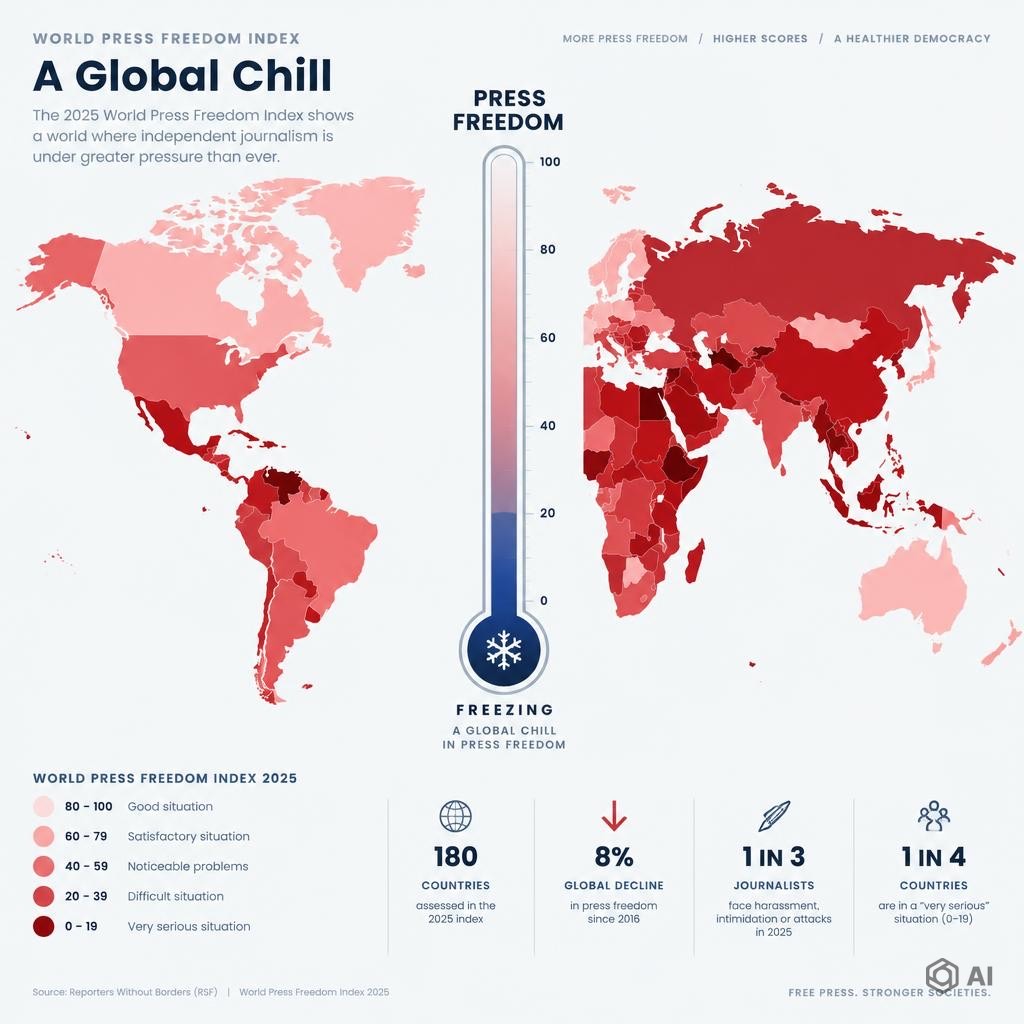
In our last post, we discussed the "Silent Cost"—how the fear of speaking out is not just a political problem, but a fundamental barrier to human agency. But if you think this silence is unique to Madagascar, you’re mistaken. We are currently witnessing a "Global Chill," and the data confirms it.
Every year, Reporters Without Borders (RSF) publishes the World Press Freedom Index. It is the gold standard for measuring how much "Agency" the press—and by extension, the people—has to hold power accountable. The 2025 results are in, and they are sobering. For the first time since the index began, the global situation is officially rated as "difficult."
The Map of Silence
The 2025 Index shows a world where the "Control" side of our spectrum is gaining ground. More than half of the world’s population now lives in countries where press freedom is classified as "very serious." In just five years, the number of countries in the "bright-red" danger zone has doubled.
Why is this happening? It’s not just about censorship anymore; it’s about economic fragility. In 160 out of 180 countries, media outlets are struggling to achieve financial stability. When the press is broke, it is easily bought, easily bullied, or easily silenced.
The Great Powers and the Press
To understand the stakes, we have to look at how the world’s major players are navigating this chill:
* The "Control" Extremes (China, Russia): In these nations, the press is not just restricted; it is an arm of the state. The "Control" model is absolute. There is no ambiguity—the state dictates the narrative, and individual agency is replaced by state-mandated obedience.
* The "Hybrid" Ambiguity (India, USA): We see a different kind of pressure here. In the US, the challenge is often the erosion of trust and the fragmentation of the media landscape, which makes it hard for the public to agree on basic facts. In India, we see the use of legal and political pressure to narrow the space for dissent. These systems still have the façade of press freedom, but the reality is becoming increasingly fraught.
* The "Partner" Perspective (France, UK): Even in Europe—long considered the strongest region for press freedom—the warning lights are flashing. Economic pressures and the rise of disinformation are testing the structural foundations that allow the press to act as a check on power.
Why This Matters for Madagascar
Why should we care about global indices while we are sitting here in Antananarivo? Because the "Global Chill" provides cover for local regimes.
When the world’s great powers are busy silencing their own critics or debating the legitimacy of the press, it creates a "permissive environment" for hybrid regimes to tighten their own grip. If the global standard is falling, it becomes much easier for a local government to say, "Why should we be held to a higher standard than the rest of the world?"
The Bottom Line
The Global Chill is not an accident. It is a deliberate strategy to make the cost of speaking out so high that the average person—like the students I teach—decides it simply isn't worth the risk.
But we have to remember: Silence is a choice. When we look at the global map, we see that the decline of press freedom is not inevitable; it is a result of the trade-offs we have allowed to happen.
In our next post, we are going to stop zooming out. We are going to turn our gaze back to Madagascar, to look at the specific ways this "Global Chill" is manifesting in our own streets, our own schools, and our own lives.


Comments
Post a Comment