The Political Silence: Why Does the State Not Do More?
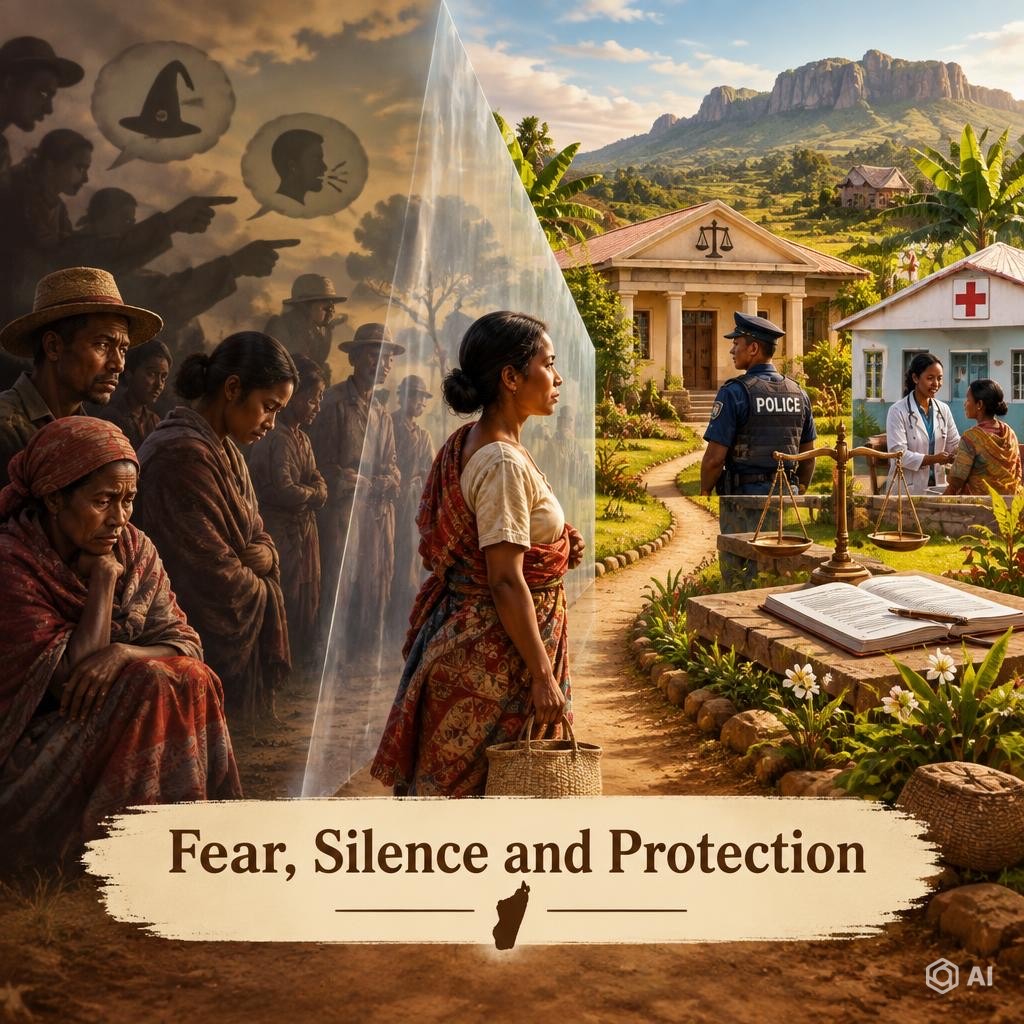
In previous posts, we explored how beliefs about witchcraft and spiritual harm vary across Madagascar. We also considered how fear can influence behaviour, relationships and access to justice.
This raises a difficult political question: if accusations can lead to intimidation, exclusion, violence or financial exploitation, why does the state not do more to prevent the abuse?
The answer is not simply that Madagascar has no laws. Legal provisions have existed against sorcery, magic and charlatanism, particularly where such practices disturb public order or harm people or property. The problem is the gap between law on paper and protection in practice.
The Limits of Legislation
A law is only effective when people can safely report abuses and trust the police, courts and local authorities to act.
In reality, a person accused of witchcraft may face:
- threats from neighbours or relatives;
- expulsion from a community;
- physical violence;
- pressure to pay a healer or spiritual authority;
- difficulty finding protection;
- fear of retaliation; or
- reluctance to involve the police.
In some cases, authorities may intervene. But enforcement can be inconsistent, particularly where local power structures, fear or political interests influence the response.
Why Political Leaders May Remain Silent
There may be several reasons for this silence.
First, the subject is culturally sensitive. A government that directly challenges popular beliefs may fear accusations that it is attacking tradition, religion or local identity.
Second, the state may lack the capacity to enforce the law consistently, particularly in rural communities where police, courts, healthcare and social services are limited.
Third, political leaders may see little immediate benefit in confronting a problem that is difficult to measure and risky to discuss publicly. It is easier to announce a new policy than to protect a vulnerable person in a remote village.
But there is also a broader political concern.
Fear as a Form of Control
In a hybrid political system, control does not always operate through direct government orders. It can also operate through fear, division and uncertainty.
If people are encouraged to fear the neighbour, the healer, the outsider or the supposed witch, their attention is directed away from wider structural problems:
- corruption;
- poor public services;
- unemployment;
- weak healthcare;
- failures of justice; and
- the misuse of public resources.
This does not prove that the government deliberately creates or promotes witchcraft accusations. That claim would require specific evidence.
However, a system can benefit from fear even when it does not openly create it. When people are divided and suspicious of one another, they are less likely to organise around shared problems or demand accountability from those in power.
The result is a form of political displacement: public anxiety is directed towards invisible enemies instead of visible institutional failures.
The Social Cost of Silence
When the state remains silent, it sends an ambiguous message. It may appear to accept that accusations, intimidation and informal punishment are simply part of community life.
This weakens citizenship. A person is no longer protected primarily by law, but by family connections, wealth, local influence or spiritual authority.
Those without protection become especially vulnerable. They may be unable to defend themselves against an accusation, obtain medical care, challenge an abusive healer or seek justice after being expelled from their community.
What Should Be Done?
Madagascar does not need a law declaring that spiritual belief is forbidden. That would violate freedom of religion and expression and would probably drive the practice underground.
It needs laws and institutions that protect people from harmful conduct, regardless of the explanation behind it.
Practical measures could include:
- clearly criminalising violence, threats, forced expulsion and exploitation linked to witchcraft accusations;
- ensuring that police record and investigate such complaints;
- protecting children, elderly people and socially isolated individuals who are especially vulnerable;
- improving access to medical diagnosis and mental-health support;
- regulating anyone who charges money for medical or spiritual treatment;
- providing public education about illness, stress and the nocebo effect;
- training local officials to distinguish cultural practice from abuse; and
- ensuring that courts, not mobs or private authorities, decide whether a crime has occurred.
The Real Test of the State
The issue is not whether every Malagasy citizen must abandon spiritual beliefs. The issue is whether people are free to hold those beliefs without being harmed—and whether those accused of witchcraft are protected from violence and exploitation.
A capable state does not need to control people’s beliefs. It must control the consequences when belief is used to threaten, punish or exploit them.
The greatest danger is not belief itself. It is the combination of belief, fear and institutional weakness.
When the state allows invisible accusations to produce visible suffering, it is failing in its most basic responsibility: protecting the agency and dignity of its citizens.


Comments
Post a Comment