The Witch Trials of History: How England Moved from Fear to Reason
The Witch Trials of History: How England Moved from Fear to Reason
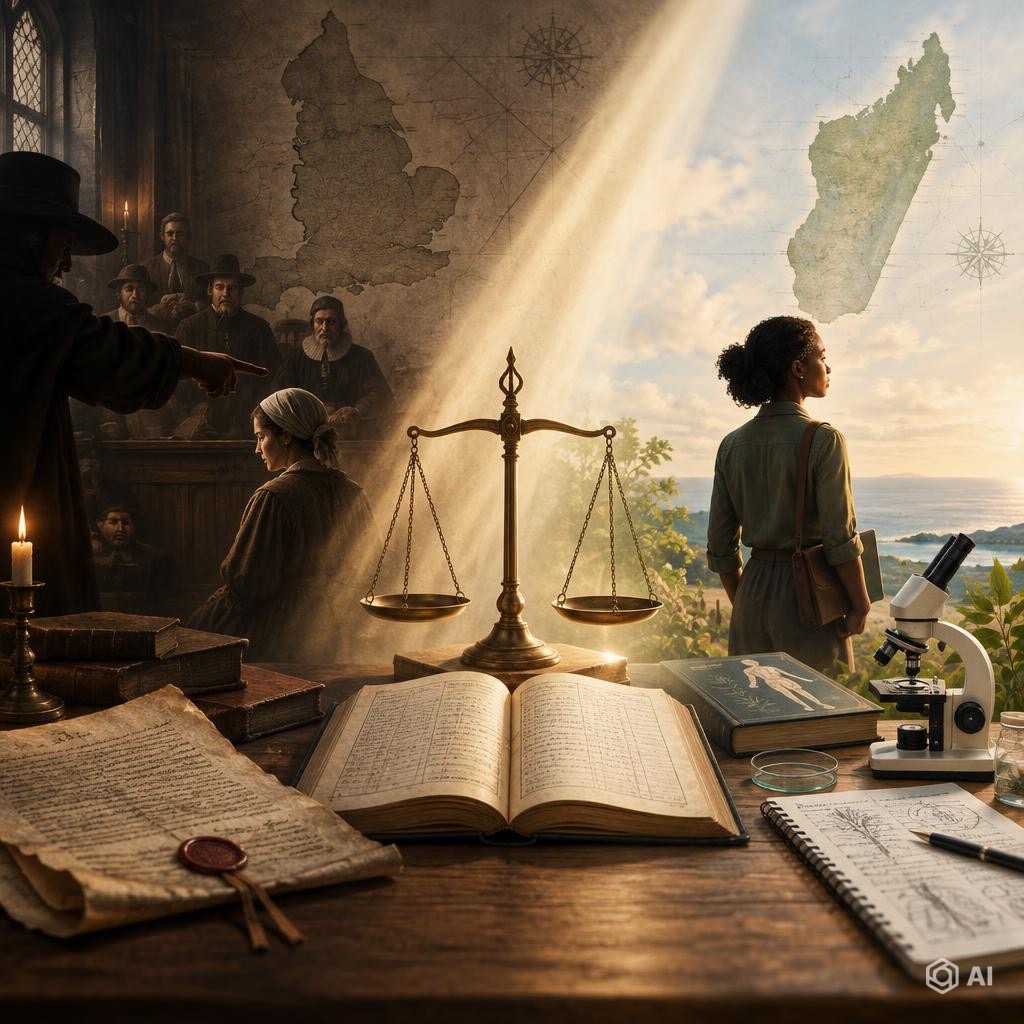
When I was a boy growing up in Guernsey, the word "witchcraft" felt like a relic of a distant, darker age. We heard the stories, but they were just that—stories. The world had moved on. England, and the West more broadly, hadn't just "stopped believing" in witches; they had undergone a profound, centuries-long transformation. They had traded a system of fear for a system of law.
But this transition wasn't a natural accident. It was a brutal, hard-won fight for Agency.
The Era of the "Invisible Wall"
In the 16th and 17th centuries, England was a place where the "Invisible Wall" of fear was very much alive. Misfortune—a crop failure, a sick cow, a sudden fever—was rarely seen as a structural problem. It was seen as the work of a neighbour , a curse, or a spiritual attack.
The law reflected this fear. In 1542, Henry VIII introduced the first Witchcraft Act, making it a felony. By 1562, Elizabeth I’s Act Against Conjurations, Enchantments and Witchcrafts reinforced these laws, and in 1604, James I strengthened them further, expanding the scope of what could be prosecuted. These were not just laws; they were tools of social regulation. If your neighbour was too successful, or if you simply didn't like them, an accusation of witchcraft was the ultimate weapon. It kept communities in a state of perpetual suspicion.
The Breakthrough: From Ordeals to Evidence
The turning point for England wasn't just "becoming more modern." It was the professionalization of the judiciary and the birth of the scientific mind.
For centuries, the legal system was a mess of private prosecutions and local superstition. The breakthrough came when the state finally insisted on evidence. The Witchcraft Act of 1735 was the turning point. It shifted the law away from treating witchcraft as a real magic and instead punished people for pretending to have magical powers or for fraudulent claims.
When the courts began to demand material proof—not rumour,not gossip, but evidence—the "witch" vanished. Once you require evidence, you remove the power of the accusation. You move the conflict from the realm of the "invisible" (where the state has total control) to the realm of the "visible" (where the individual has the agency to defend themselves).
The Science of the Unexplained
This legal shift was mirrored by a scientific one. As we began to understand the germ theory of disease, the mechanics of crop failures, and the laws of physics, the "gaps" where witchcraft lived began to close. We learned that misfortune is not a moral judgment—it is a structural problem that can be solved.
Faith, Power and the Fear of Witchcraft
It is important to distinguish between faith in a higher power and fear of witchcraft. Belief in God, ancestors, or a spiritual order can provide meaning, comfort, moral guidance, and solidarity. It can help people endure suffering without blaming a neighbour or seeking revenge.
Witchcraft accusations operate differently. They often turn unexplained misfortune into suspicion directed at a particular person. A failed harvest, illness, family dispute, or personal setback may be interpreted as evidence that someone has caused harm through supernatural means. Once an accusation takes hold, it can lead to isolation, punishment, or exploitation.
The common feature is the question of who controls the explanation. If religious or spiritual authorities use fear to prevent questions, they can become instruments of control. But faith can also challenge control when it insists on human dignity, justice, compassion, and accountability.
The goal is therefore not to attack religion. It is to ask whether a belief system helps people respond to suffering with evidence, solidarity, and responsibility—or whether it encourages fear, accusation, and submission.
Why the "England" Lesson Matters for Madagascar
I often say that in many areas, Madagascar is between 50 and 250 years behind the development of a stable liberal democracy. This isn't a judgment; it’s a historical observation.
When I see the fear of witchcraft here today, I don't see a "primitive" culture. I see a society that is still operating in a historical stage where the state has not yet provided the legal infrastructure to replace fear with reason.
* In England, the transition happened because the law became a neutral referee.
* In Madagascar, when the law is not a referee—when the police and judiciary are seen as tools of control rather than protection—people must look elsewhere for security. They look to the spiritual, the occult, and the protective powers of the "Invisible Wall" because they have no other choice.
The Path to Agency
The lesson from history is clear: You cannot "educate" a population out of fearing the supernatural if the state is not providing a reliable, rule-based alternative.
If we want to see the fear of the occult decline in Madagascar, we don't need more moralizing. We need the same thing England fought for: a judiciary that is a neutral referee. We need a system where a dispute over a field, a debt, or a grievance is settled by evidence, not by the fear of a curse.
The move from "Fear" to "Reason" is the move from "Subject" to "Citizen." It is the ultimate act of Agency.
In our next post, we will look at how this fear manifests across the different regions of Madagascar today, and why the "Invisible Wall" remains such a potent tool for those who want to keep us divided.


Comments
Post a Comment