Aid, Influence or Independence? Madagascar’s Economic Choice
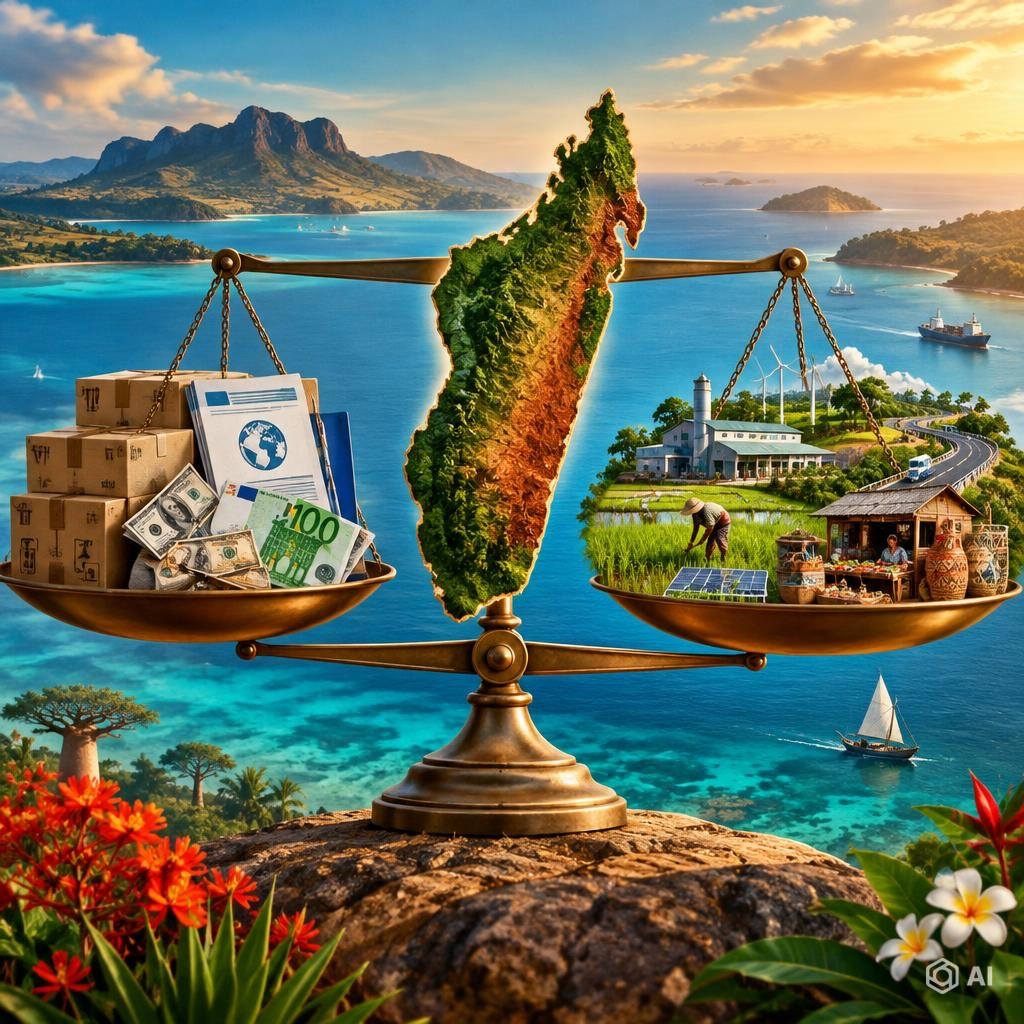
The Government’s decision to maintain fuel prices and avoid taxing rice and cooking oil is presented as a measure to protect households and control inflation. The Minister of Economy and Finance, Dr. Herinjatovo Aimé Ramiarison, has also highlighted the stability of the exchange rate and the fact that foreign-currency reserves now cover approximately seven months of imports.
These are important indicators. They suggest that Madagascar currently has a degree of financial protection and that the Government is trying to preserve public confidence. In a country where rising prices quickly affect social stability, protecting the purchasing power of households is understandable.
But these measures also raise a more fundamental question:
Is Madagascar moving towards economic independence, or is it becoming more effective at attracting external assistance?
Seven months of import cover is reassuring, but foreign reserves do not necessarily prove that an economy is becoming self-sufficient. Reserves may be supported by donor funding, borrowing, remittances, foreign investment or temporary external inflows. They provide a buffer against crisis, but they do not automatically create domestic production, jobs or public revenue.
The same applies to price controls. Keeping fuel, rice and cooking oil affordable may reduce immediate hardship. However, if the underlying economy remains dependent on imported fuel and food, price stability can become expensive to maintain. The Government may succeed in postponing social pressure without resolving the structural causes of that pressure.
Madagascar possesses considerable geopolitical importance. Its position in the Indian Ocean, its natural resources, biodiversity and strategic location make it significant to international partners. This can help the country attract development assistance, investment and diplomatic attention.
There is nothing wrong with using that position intelligently. Every country seeks to benefit from its geography and resources. The danger arises when geopolitical importance becomes a substitute for reform.
Aid can help build roads, schools, hospitals and energy systems. It can support public finances during difficult periods. But it cannot permanently replace a functioning domestic tax system, productive businesses and accountable institutions. If external support mainly helps the Government maintain stability without transforming the economy, dependence may simply become more comfortable rather than less permanent.
A credible path towards greater independence would require several difficult reforms. Madagascar would need to collect more domestic revenue, reduce corruption, improve the reliability of electricity and transport, increase agricultural production and encourage businesses to operate more easily. The country would also need to process more of its own natural resources instead of exporting them with limited added value.
The objective should not be to reject aid. The objective should be to use aid as a bridge.
External assistance should help Madagascar develop the capacity to finance more of its own priorities in the future. It should strengthen institutions rather than compensate indefinitely for their weakness. It should support production rather than merely fund consumption.
Economic and social stability are certainly prerequisites for development. But stability alone is not development. A country can remain stable while its people continue to depend on imported goods, foreign financing and emergency support.
Madagascar’s geopolitical position may attract assistance. Its reserves may reassure donors and investors. Its price policies may reduce immediate hardship. But long-term independence will depend on whether the country can convert these advantages into domestic production, stronger public finances and better governance.
The essential question is therefore not whether Madagascar can attract aid.
It is whether Madagascar has a plan to make aid less necessary.


Comments
Post a Comment