Breaking the Pyramid of Corruption: Leadership, Justice and Madagascar’s Reform Challenge Part 6: Leadership
Part 6: Leadership
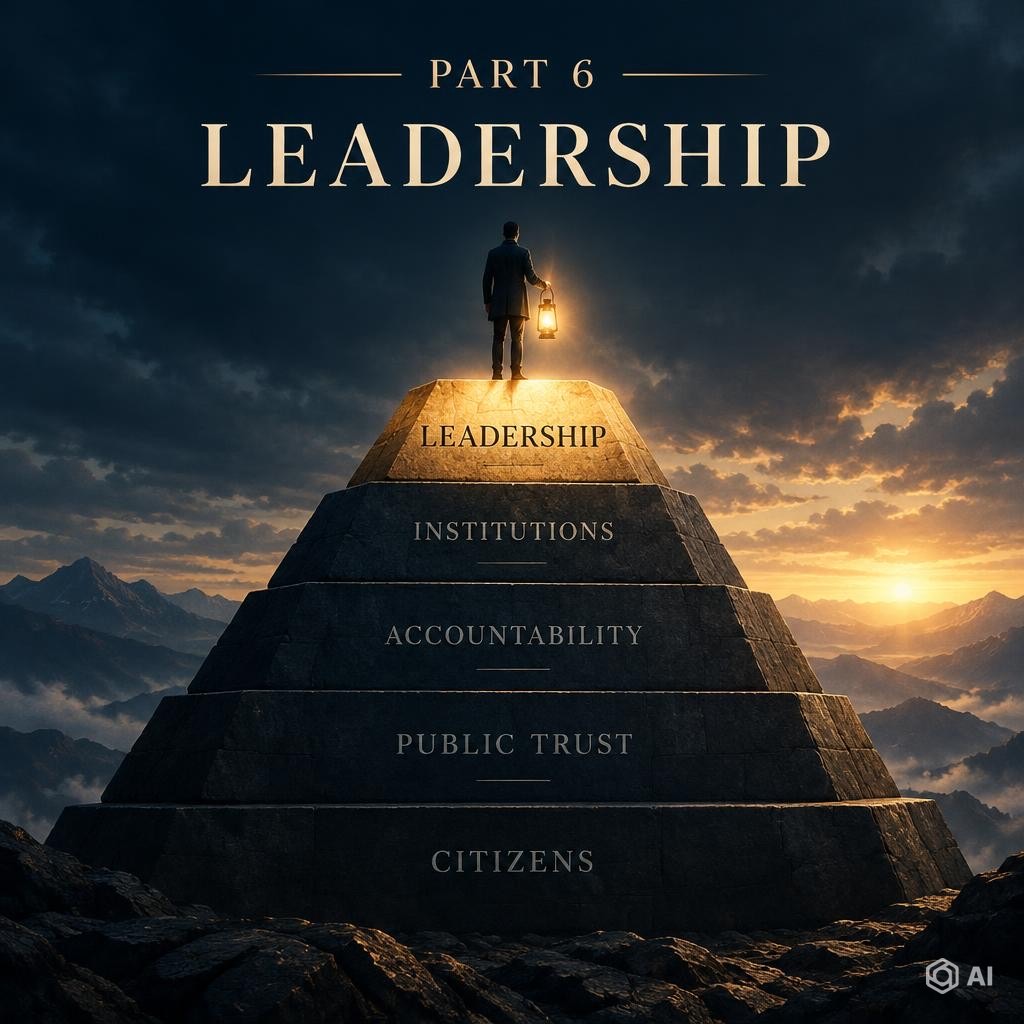
Leadership is often presented as power, authority and control. In reality, leadership is measured by responsibility: the willingness to make difficult decisions, accept consequences and place the public interest above personal advantage.
This is especially important when discussing corruption. Corruption is not sustained by dishonest individuals alone. It survives when leaders tolerate it, benefit from it or fail to challenge it. A corrupt system therefore reflects not only the actions of those who take bribes, but also the decisions of those who allow such behaviour to continue.
Leadership sets the standard
Every organisation takes its direction from the example set at the top.
If leaders respect the law, demand transparency and treat public resources as a public trust, these values can spread throughout government and society. But when leaders use public office for private gain, reward loyalty instead of competence, or protect those accused of wrongdoing, they send a very different message:
The rules apply to ordinary people, but not to those with influence.
This destroys trust. It also encourages people to believe that corruption is not an exception to the system—it is the system.
The difference between authority and leadership
Authority gives a person the power to issue orders. Leadership gives people a reason to follow.
A government may have the authority to collect taxes, enforce regulations and manage public finances. But it will not be regarded as legitimate if citizens cannot see where money is going, why decisions are made or whether officials are held accountable.
True leadership requires more than speeches and promises. It requires:
- clear priorities;
- honest communication;
- competent administration;
- transparent use of public money;
- fair enforcement of the law; and
- consequences for abuse of office.
Without these principles, leadership becomes performance rather than service.
Leadership and public money
Corruption is often discussed as though it concerns only large contracts or dramatic scandals. But weak leadership can also be seen in ordinary failures: unpaid workers, delayed services, missing medicines, poor roads and schools that lack basic resources.
When public money disappears or is mismanaged, the consequences are carried by ordinary citizens. Families pay more, businesses struggle and public servants lose motivation. Eventually, people may begin to believe that paying a bribe is the only way to obtain a service to which they are already entitled.
That is how corruption becomes normalised.
Leaders must therefore treat public finance as a moral responsibility, not simply an accounting exercise. Budgets should be understandable. Procurement should be open. Payments should be traceable. Officials should be answerable for both decisions and failures.
Leadership must be shared
The responsibility for change does not belong only to presidents, ministers or senior officials. It also belongs to parliamentarians, judges, civil servants, business leaders, religious leaders, journalists, teachers and citizens.
A society cannot demand honest government while rewarding dishonesty in private life. Nor can reform succeed if people remain silent when corruption benefits them personally.
However, shared responsibility does not mean equal responsibility. Those with greater power have greater obligations. A junior official may feel pressured to obey an unlawful instruction, while a senior leader has the authority to prevent it. The higher the position, the greater the duty to act.
From fear to responsibility
Corruption grows where people feel powerless. They may fear losing their job, access to services or protection from authority. This fear encourages silence and dependence.
Leadership should do the opposite. It should give people confidence that they can speak, participate and demand better standards without retaliation.
This means protecting whistle-blowers, supporting independent journalism, strengthening oversight bodies and allowing citizens to question decisions. It also means recognising that criticism is not necessarily disloyalty. In a healthy democracy, criticism can be a form of public service.
The choice before Madagascar
Madagascar does not lack people with ability, intelligence or commitment. The deeper challenge is whether its institutions and leaders will create an environment in which integrity is rewarded and corruption is punished.
Leadership is ultimately a choice. Leaders can preserve the existing pyramid by protecting privilege and discouraging questions. Or they can begin dismantling it by accepting scrutiny, strengthening institutions and placing public service above personal power.
The first step is to recognise the truth: corruption cannot be defeated by changing a few individuals while leaving the system untouched.
Part 7 will examine what it means to break that system—and how citizens, institutions and leaders can begin to replace coercion with accountability.


Comments
Post a Comment