Democracy in Madagascar: Beyond the Ballot Box
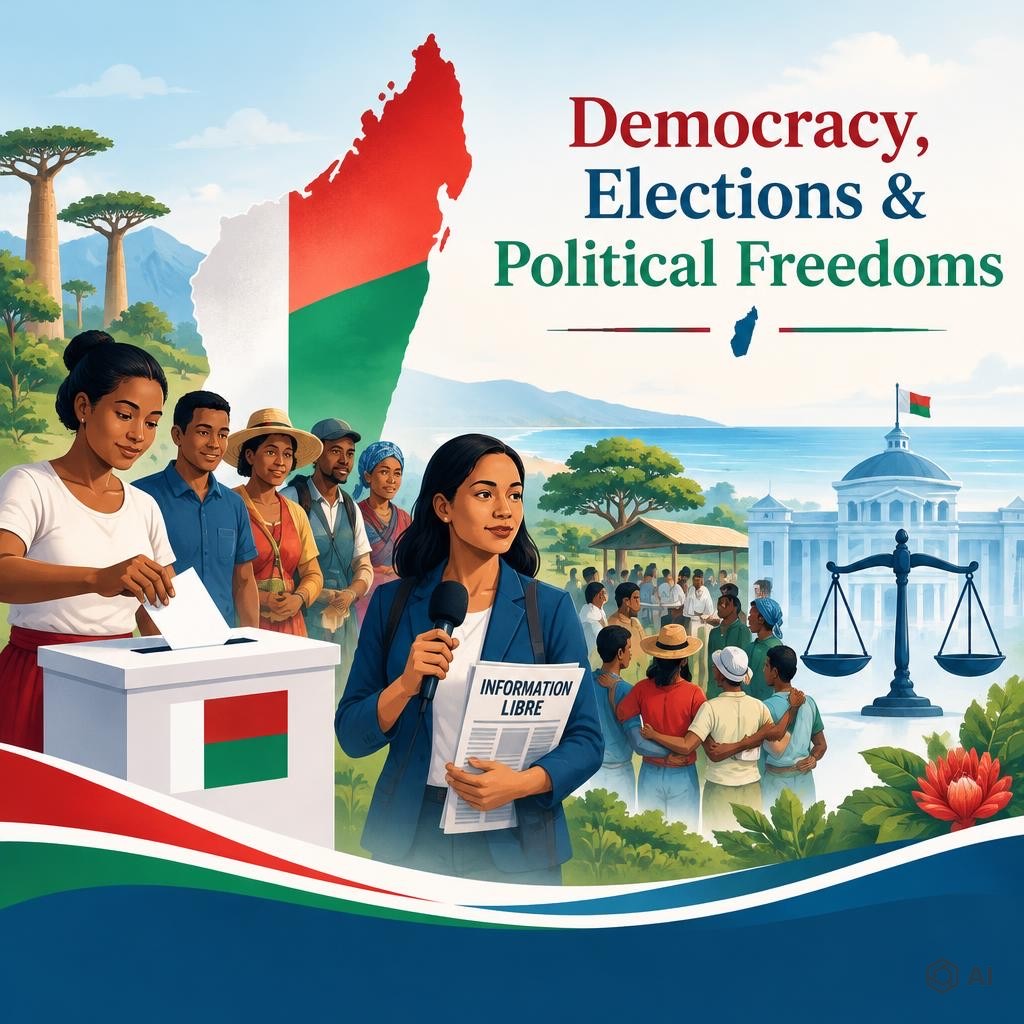
Democracy is often measured by one visible event: the holding of elections. But elections are only the beginning. A meaningful democracy also requires freedom of expression, political participation, independent institutions, peaceful opposition and government that can be questioned and held accountable.
Madagascar has made formal commitments to these principles through the International Covenant on Civil and Political Rights, the African Charter on Human and Peoples’ Rights, and the African Charter on Democracy, Elections and Governance. The country has also continued to hold elections and maintain elected institutions.
The important question, however, is not simply whether Madagascar holds elections. It is whether citizens are genuinely free to choose, criticise, organise and participate in public life.
Elections: progress with serious limitations
Madagascar held legislative elections in May 2024 and local elections later that year. These elections were significant because they demonstrated the continuation of constitutional and electoral processes. Legislative turnout also increased compared with the previous election.
These developments should not be dismissed. Elections provide a peaceful alternative to political violence and create an opportunity for citizens to influence the direction of the country.
However, an election is not automatically democratic because ballot boxes are present. Voters must have a genuine choice. Opposition parties must be able to campaign freely. Candidates must have fair access to media and public spaces. State resources must not be used to give one political group an unfair advantage.
Concerns about voter registration, media imbalance, misuse of public resources and alleged irregularities weakened confidence in the process. When citizens believe that the result is predetermined or that political competition is unequal, participation and trust inevitably decline.
Freedom of expression is a democratic foundation
Citizens cannot make informed political choices if they cannot freely discuss public affairs.
Freedom of expression allows people to question government policy, expose corruption, debate national priorities and propose alternatives. It also protects journalists, civil-society organisations and ordinary citizens who speak about problems affecting their communities.
Madagascar’s legal framework recognises freedom of expression and contains important protections for the media. Yet legal guarantees are not enough. Journalists and citizens may still face intimidation, legal pressure or administrative restrictions. Media ownership and political influence can also narrow the range of views available to the public.
A democracy becomes weaker when criticism is treated as disloyalty. Governments should not confuse political opposition with a threat to national stability. Peaceful criticism is not an attack on the country. It is one of the ways citizens help to improve it.
Association and peaceful assembly
Democracy also depends on the ability of people to organise.
Political parties, trade unions, churches, community groups, charities and human-rights organisations give citizens collective strength. They allow people to raise concerns that may be ignored when expressed individually.
The right to peaceful assembly is equally important. Citizens should be able to demonstrate, attend meetings and express dissatisfaction without fear of intimidation or unnecessary force.
When permits are denied selectively, opposition gatherings are restricted or civil-society groups are placed under pressure, public participation becomes unequal. People may still have rights on paper, but they are less able to use them in practice.
A government committed to democracy should protect peaceful gatherings, including gatherings that are critical of the government. Public order is important, but it must not become a general excuse for suppressing political disagreement.
Political participation must go beyond voting
Political participation is broader than casting a ballot every few years. It includes:
- access to reliable information;
- the ability to join a political party or civil-society organisation;
- the freedom to stand for election;
- equal access to public institutions;
- involvement in local decision-making;
- the ability to petition and challenge public authorities.
Many citizens in Madagascar remain distant from political decision-making. Poverty, geography, limited access to information and weak public services all affect a person’s ability to participate.
A person who is struggling to find food, employment, healthcare or education may have little time or confidence to engage politically. This is why democracy cannot be separated from living conditions. Political rights are difficult to exercise when people are excluded economically and socially.
Accountable government
The final test of democracy is accountability.
Elected officials should explain how public money is used. Government decisions should be transparent. Parliament, courts, audit bodies, journalists and civil society should be able to examine official conduct. Where corruption or abuse occurs, investigations should be independent and effective.
Madagascar continues to face challenges involving corruption, weak oversight, impunity and limited transparency. These problems damage more than public finances. They weaken the relationship between citizens and the state.
When people believe that officials are not answerable for their actions, trust disappears. Citizens may conclude that voting changes little, that complaints will not be heard and that public institutions serve the powerful rather than the public.
Accountability therefore requires more than promises. It requires functioning institutions, independent investigations, credible courts, accessible information and consequences for wrongdoing.
Measuring the achievements
Madagascar’s achievements should be recognised fairly:
- elections have continued to take place;
- elected institutions remain in operation;
- the country has accepted important international and African democratic obligations;
- legal protections for expression, association and participation exist;
- citizens and civil-society organisations continue to demand reform.
But these achievements remain incomplete. Formal institutions do not always provide genuine political equality. Elections do not always create a level playing field. Freedom of expression remains vulnerable, and accountability mechanisms are not yet strong enough to prevent abuse or restore public confidence.
The central problem is the gap between rights on paper and rights in practice.
From formal democracy to meaningful democracy
Madagascar does not need democracy only during election periods. It needs democracy in everyday government.
That means citizens should be able to question decisions without fear. Journalists should be able to investigate without intimidation. Opposition parties should be able to organise without unnecessary restrictions. Civil-society groups should be treated as partners in national development rather than as political enemies.
Most importantly, government should understand that accountability strengthens the state. Listening to criticism does not weaken authority. It makes authority more legitimate.
Madagascar has created some of the formal structures required by democratic governance. The next challenge is to make those structures work fairly and consistently for everyone.
Democracy is not simply the right to vote. It is the continuing right to be heard, to participate, to organise, to criticise and to expect government to answer.
Overall assessment
Madagascar has achieved partial democratic progress, particularly through the continuation of elections and the maintenance of formal legal commitments. However, the country has not yet achieved a fully open, competitive and accountable political system.
The future of democracy in Madagascar will depend on whether constitutional promises become practical freedoms—and whether citizens can use those freedoms without fear.


Comments
Post a Comment