Diplomacy Without Embassies: Rethinking Madagascar’s Overseas Representation
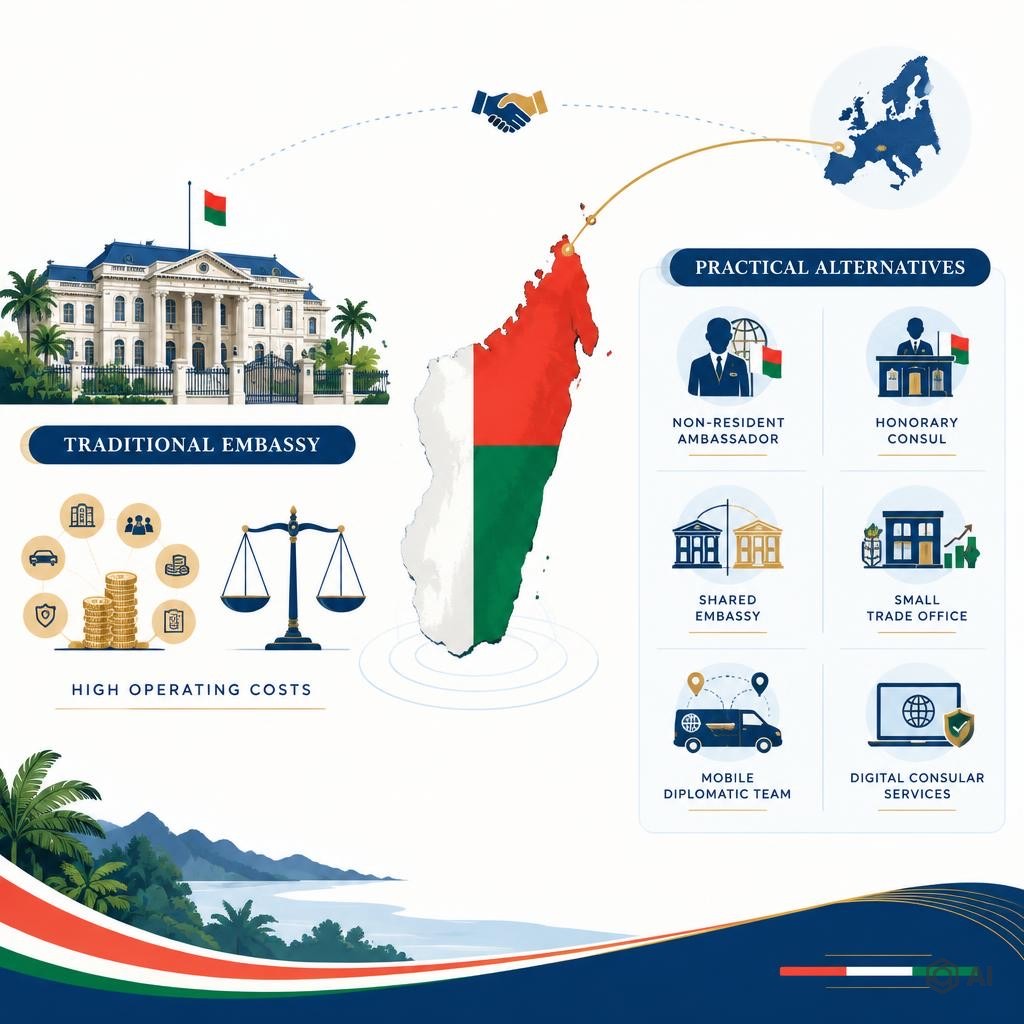
Why does Madagascar maintain diplomatic relations with countries where it has no resident ambassador, while those countries maintain embassies in Antananarivo?
This question was recently raised by Colonel Michaël Randrianirina, president of the Refondation movement, during a meeting with members of the Malagasy diaspora in Turkey. His argument was straightforward: embassies are expensive, and Madagascar must carefully consider whether each mission produces sufficient national benefit.
That is a reasonable question. Diplomacy is not free. An embassy requires premises, security, transport, administrative support and salaries. The ambassador’s salary is only one part of the cost. In a country with limited public resources, every overseas mission must be judged against competing priorities at home, including education, healthcare, infrastructure and public administration.
However, the value of an embassy cannot be measured only by immediate financial returns.
Diplomacy is about interests
An embassy should serve clearly defined national interests. These may include trade, tourism, investment, education, security, political cooperation and support for citizens abroad.
In the case of Turkey, for example, Madagascar would need to consider what a permanent mission could realistically achieve. Could it attract Turkish investment? Could it increase tourism? Could it support Malagasy students? Could it improve access to Turkish markets? Could it strengthen cooperation in agriculture, construction, health or education?
If the answer is yes, a diplomatic presence may be justified. If the relationship produces little practical benefit, Madagascar may reasonably choose a less expensive form of representation.
The important point is that diplomatic policy should be strategic rather than symbolic. Madagascar does not need embassies simply because other countries have them, or because diplomatic reciprocity looks attractive. It needs representation where that representation advances the country’s interests.
The importance of the diaspora
At the same time, the Malagasy diaspora should not be treated only as a financial resource or a source of remittances. Overseas citizens are also part of Madagascar’s national community.
They may need assistance with passports, documents, legal problems, emergencies, education and communication with Malagasy authorities. They may also be able to promote investment, tourism and cultural exchange.
For this reason, the absence of an embassy does not mean the absence of responsibility. If Madagascar decides that a full embassy is too expensive, it should still provide practical and accessible consular services.
Alternatives to a full embassy
There are several possible alternatives.
A non-resident ambassador could be accredited to several countries from a regional base. This would maintain formal diplomatic relations without the cost of a separate embassy.
An honorary consul could provide basic assistance to Malagasy citizens and help develop commercial and cultural contacts. This would not replace a full diplomatic mission, but it could offer a useful local presence.
Madagascar could also establish a small trade or consular office rather than a complete embassy. Such an office might focus on investment, tourism, student support and citizen services.
Another possibility is a shared embassy, in which Madagascar cooperates with a friendly country and shares premises or administrative resources. Regional cooperation could reduce costs while preserving diplomatic access.
Regular visits by diplomatic officials could also be organised. A mobile diplomatic team might provide consular services at scheduled times in cities where Malagasy citizens live.
Finally, digital services should be improved. Online appointments, document applications and communication platforms cannot replace personal assistance in every situation, but they can reduce administrative costs and make government services more accessible.
The benefits of a permanent mission
A full embassy does offer advantages. It provides continuous political contact with the host government and allows Madagascar to respond quickly to changing circumstances.
An embassy can also build relationships with businesses, universities, local authorities and civil society organisations. These relationships may eventually produce benefits that are difficult to measure in the first year or two.
Diplomacy is sometimes an investment in future opportunities. A mission may not immediately generate revenue, but it can create the trust and networks needed for future cooperation.
A question of value, not prestige
The debate should therefore move beyond a simple choice between opening or closing embassies. The real question is:
What form of diplomatic representation provides the greatest benefit to Madagascar at the lowest sustainable cost?
Some countries may justify a full embassy. Others may require only a non-resident ambassador, honorary consul or regional office.
Madagascar’s resources are limited, and its diplomatic network should reflect that reality. But saving money must not become an excuse for neglecting the diaspora or abandoning important international opportunities.
Good diplomacy is not necessarily about having the largest number of embassies. It is about having the right presence, in the right places, for the right reasons.


Comments
Post a Comment