Environmental Treaties: Commitments, Control and Responsibility
Environmental protection is not solely a domestic issue. Through international treaties, Madagascar has accepted responsibilities concerning climate change, biodiversity, forests, wetlands and endangered species. These agreements create opportunities for international cooperation, but they also raise questions about sovereignty, enforcement and accountability.
Treaty obligations accepted by Madagascar
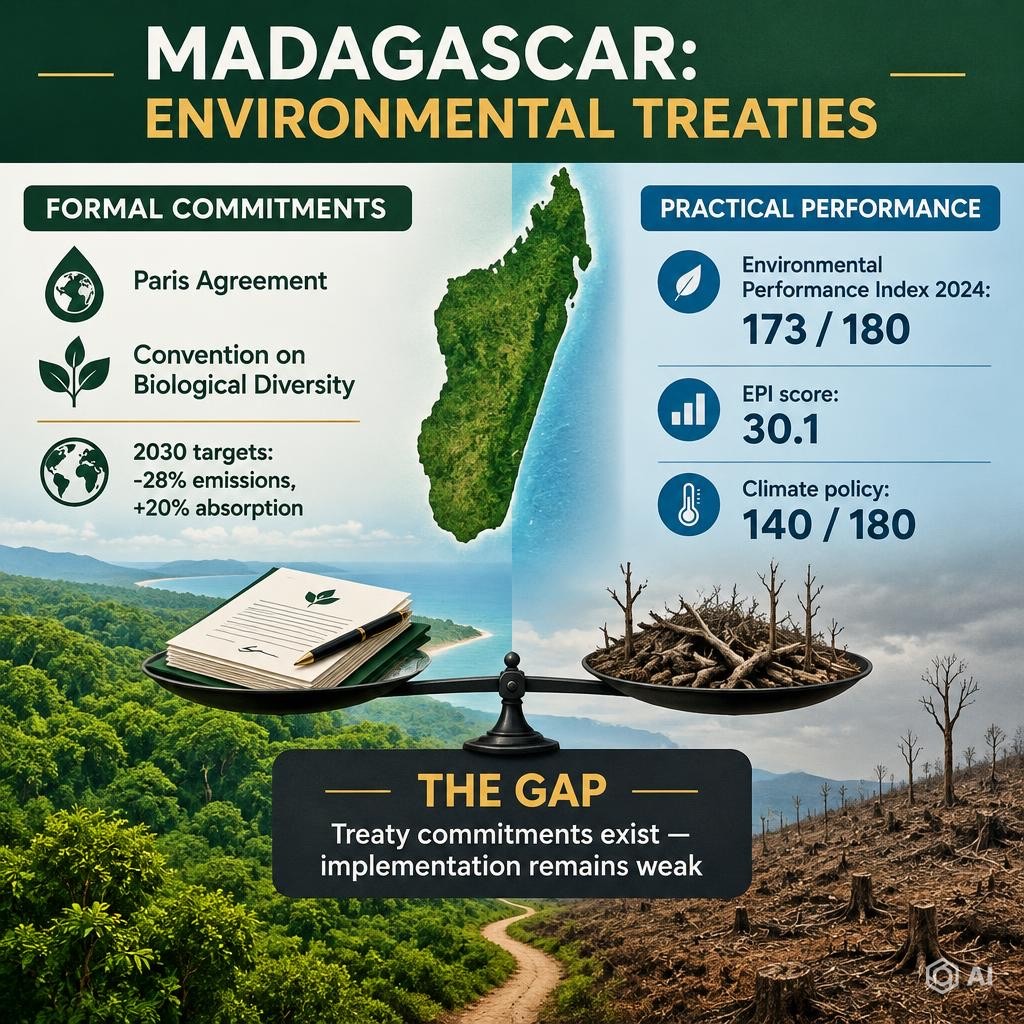
Madagascar is party to major environmental agreements, including the Paris Agreement and the Convention on Biological Diversity. It has also developed national plans for climate adaptation, biodiversity protection and emissions reduction.
By 2030, Madagascar aims to reduce greenhouse-gas emissions by 28% and increase its capacity to absorb greenhouse gases by approximately 20%. These targets demonstrate that the country has established a formal policy framework.
However, signing treaties and adopting national plans is only the beginning. The important question is whether these commitments produce measurable improvements.
How well is Madagascar performing?
The available evidence suggests a significant gap between formal commitments and practical results. The 2024 Environmental Performance Index ranked Madagascar 173rd out of 180 countries, with a score of 30.1.
Climate policy is a particular weakness. Madagascar was ranked 140th for climate policy, with a score of 28.4, representing a substantial decline over the previous decade. These figures do not directly measure legal compliance with each treaty, but they provide useful evidence of environmental outcomes and policy effectiveness.
Madagascar’s biodiversity is globally exceptional, yet habitat loss, deforestation and weak species protection continue to undermine its treaty commitments. More than 90% of energy consumption is reportedly supplied by firewood and charcoal, creating further pressure on forests.
Madagascar therefore appears to be institutionally committed but operationally underperforming.
National implementation and enforcement
Environmental treaties depend on national implementation. Government agencies must protect forests, regulate mining, prevent illegal logging and control the trade in endangered species.
In practice, enforcement is complicated by poverty, limited state capacity, corruption and the economic pressures facing local communities. A law may exist on paper while illegal activities continue.
This reveals a gap between formal control and effective control. The state possesses legal authority, but without sufficient resources and political will, that authority remains weak.
The role of sovereignty
International treaties do not eliminate Madagascar’s sovereignty. The country remains responsible for managing its own territory and natural resources.
However, sovereignty also involves responsibility. Having accepted international commitments, Madagascar must be prepared to report on its progress and explain why targets are not being achieved.
The international community may provide funding, technical assistance and pressure, but it cannot substitute entirely for national leadership.
International funding and responsibility
Many environmental programmes depend on foreign governments, international organisations and non-governmental agencies. This support can fund conservation, reforestation, climate adaptation and community development.
Nevertheless, donor support must be transparent and reliable. Local communities should not be excluded from decisions affecting their land and livelihoods, and international funding must reach the projects for which it was intended.
Responsibility is therefore shared. International partners should provide meaningful support, while Madagascar must ensure that resources are properly managed and environmental laws are fairly enforced.
The gap between commitments and results
The central issue is not whether Madagascar has signed environmental treaties. It is whether those treaties improve conditions on the ground.
At present, Madagascar has national plans, targets and reporting mechanisms, but weak enforcement, deforestation, dependence on charcoal and limited climate-policy progress continue to undermine delivery.
The country’s environmental performance illustrates the broader challenge of international treaties: agency is formally accepted, but control remains limited. Madagascar has the authority to act, yet its ability to convert international commitments into practical results is still seriously constrained.


Comments
Post a Comment