Human Rights and the Malagasy State
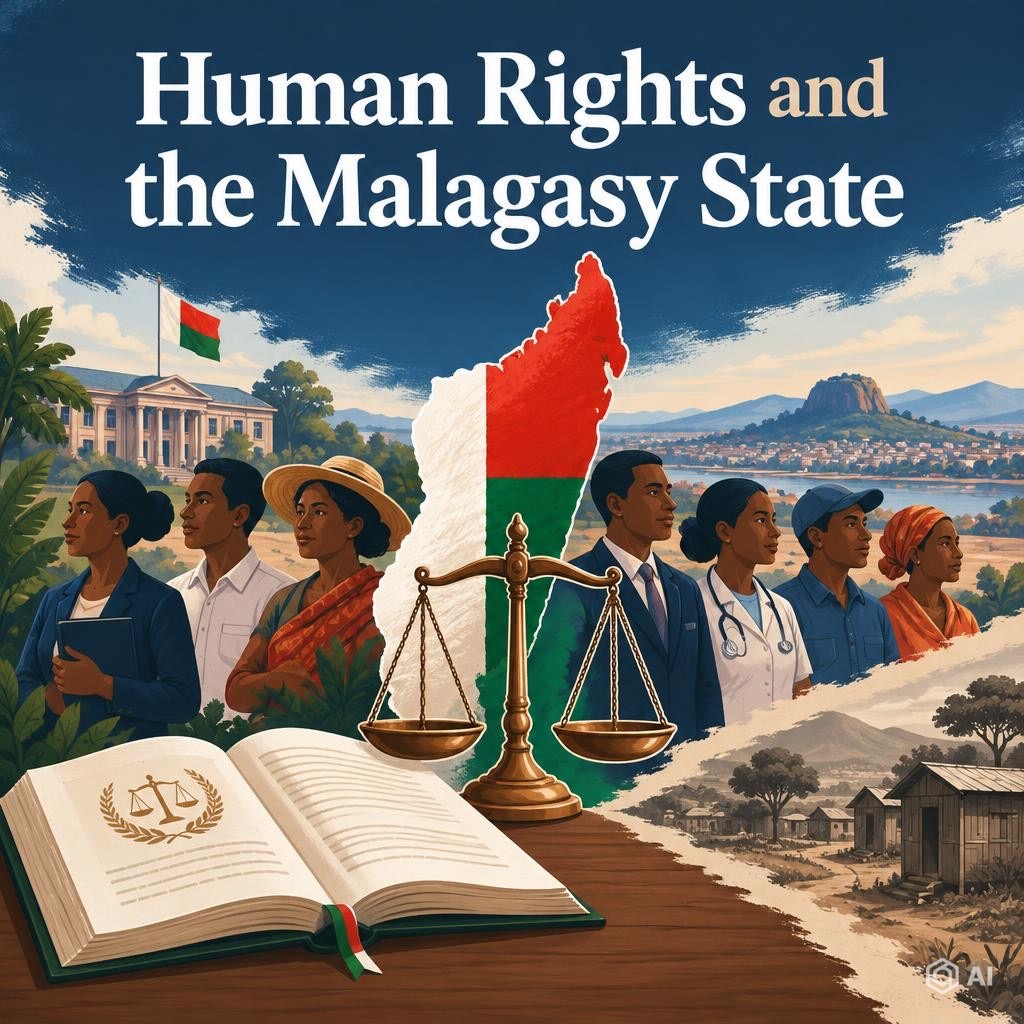
International treaties establish promises. Human-rights indicators help us examine whether those promises are being delivered.
Madagascar has accepted major international obligations through instruments including the International Covenant on Civil and Political Rights, the International Covenant on Economic, Social and Cultural Rights, and the African Charter on Human and Peoples’ Rights.
These commitments cover political freedoms, access to justice, equality, education, healthcare, employment and social protection. More than fifty years after ratifying the two UN Covenants, the question is no longer whether Madagascar has made international promises. The question is whether those promises have produced meaningful change.
The evidence suggests that delivery remains seriously inadequate.
Measuring the record
Three international indicators provide a useful starting point:
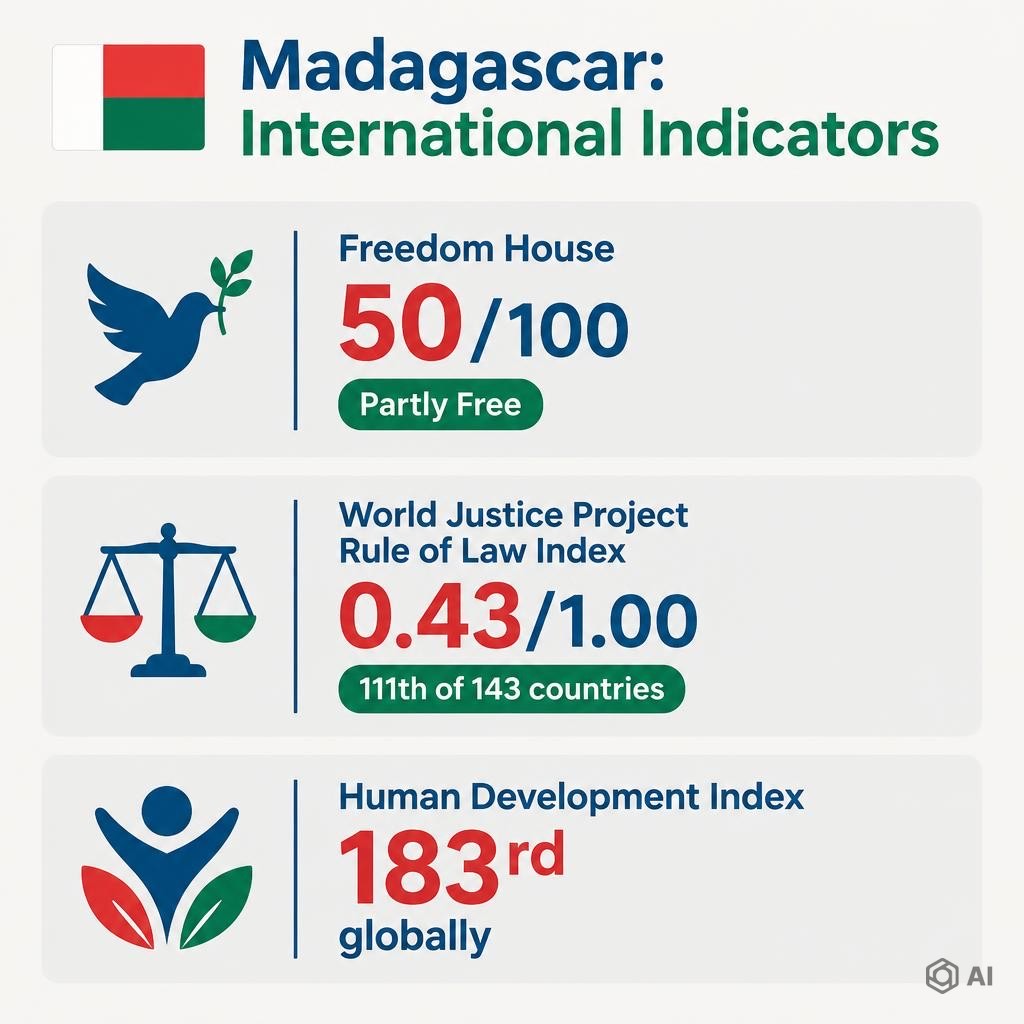
These measures do not capture every aspect of Malagasy life. Nor should a country’s human-rights record be reduced to rankings alone. However, they reveal whether political freedoms, legal institutions and social conditions are moving in the direction promised by international commitments.
On this matrix, Madagascar is failing to deliver consistently.
What was promised?
Civil and political rights require the state to protect freedom of expression, association, political participation and equal treatment before the law.
Economic and social rights require the state to make sustained progress in education, healthcare, employment, housing and social protection. These rights may depend on resources, but limited resources do not remove the obligation to act fairly, reduce discrimination and use available resources effectively.
Ratification therefore created responsibilities for the Malagasy government. It required more than formal recognition of rights. It required laws, institutions, budgets and public officials capable of turning those rights into reality.
What has happened since ratification?
Madagascar has made some formal progress. It has joined international and regional human-rights systems, adopted legal protections and participated in international review processes.
But formal commitment has not produced consistent practical protection.
Freedom House classifies Madagascar as Partly Free, indicating continuing weaknesses in political rights and civil liberties. The Rule of Law Index places the country near the lower end internationally, reflecting problems involving corruption, justice, regulatory enforcement and institutional accountability. The country’s very low Human Development Index ranking demonstrates the continuing failure to provide adequate social and economic opportunities.
These results suggest that ratification has not been followed by sustained institutional improvement.
Political crises, poverty, corruption, weak administration and limited public resources have repeatedly interrupted progress. Improvements have been fragile, and many citizens remain unable to rely on their rights in everyday life.
The difference between a right and access to a right
A right written into a constitution or treaty is not necessarily a right enjoyed in practice.
Freedom of expression is weakened if journalists, activists or citizens fear intimidation. The right to justice is weakened if courts are slow, inaccessible or vulnerable to influence. The right to education is weakened when schools lack teachers and materials. The right to healthcare is weakened when services are unaffordable or unavailable outside major centres.
For many Malagasy citizens, the problem is therefore not that rights are completely absent. It is that access to them is uncertain, unequal and dependent on geography, income or personal connections.
This is the implementation gap: the distance between what Madagascar has promised internationally and what the state can reliably provide domestically.
What does Madagascar aspire to be?
Madagascar should aspire to become a state in which:
- citizens can criticise government without fear;
- elections provide meaningful political choice;
- courts deliver equal and timely justice;
- public officials are accountable;
- children receive quality education;
- healthcare is accessible beyond the main cities;
- women and vulnerable groups are protected;
- public resources are used transparently; and
- international commitments are reflected in daily life.
These are not foreign demands imposed on Madagascar. They are consistent with the obligations Madagascar has voluntarily accepted.
Agency or control?
International treaties can strengthen Madagascar’s agency. They give citizens recognised standards, provide a basis for accountability and create opportunities for international cooperation.
But when commitments remain unimplemented, the opposite can occur. Madagascar becomes dependent on foreign monitoring, donor funding and external pressure, while its own institutions remain too weak to guarantee rights.
The country’s human-rights problem is therefore not a lack of promises. It is a failure of delivery.
Madagascar has accepted the language of universal rights. Its challenge now is to build the institutions capable of honouring that language. Until then, international commitments will remain more visible in treaties and reports than in the lived experience of Malagasy citizens.


Comments
Post a Comment