Madagascar’s 2027 Election: A Geopolitical Test Beyond the Ballot Box
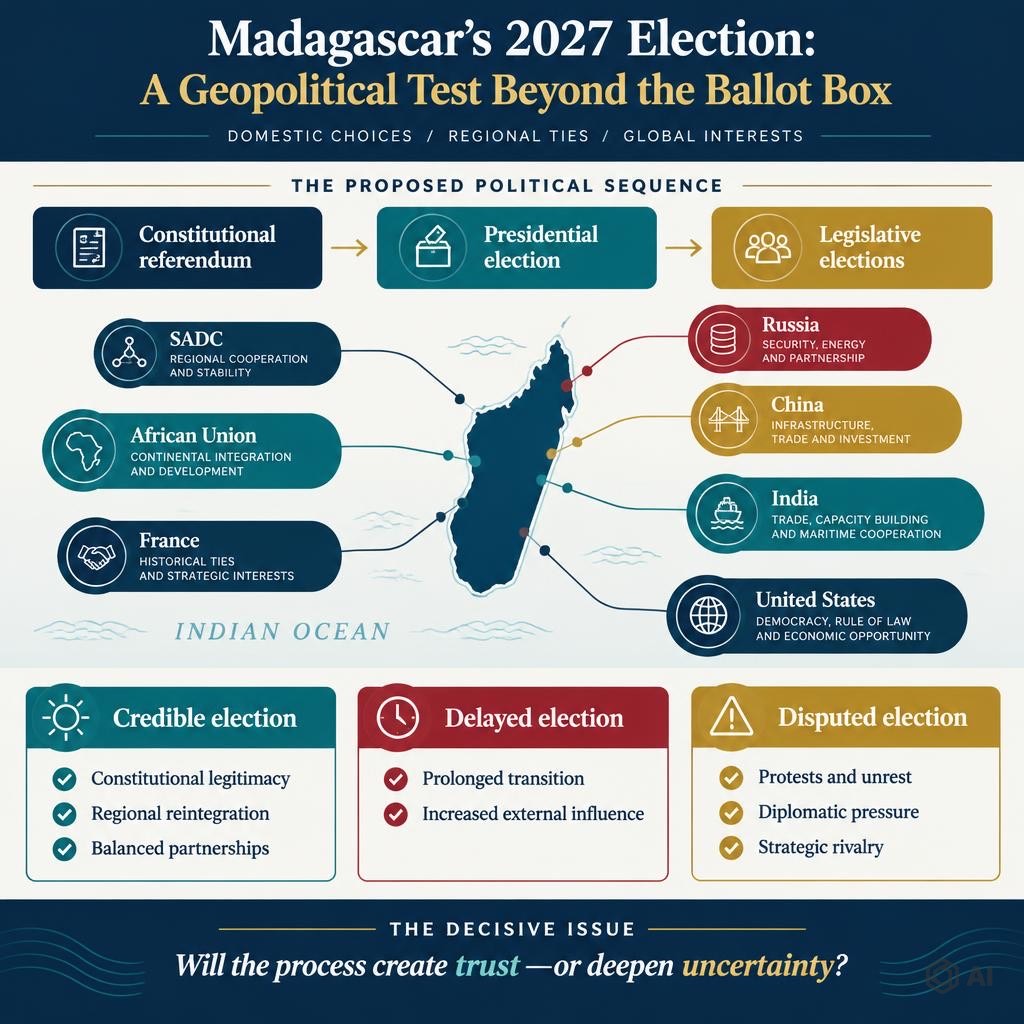
Madagascar’s proposed 2027 presidential election will be more than a domestic political event. It could become a major test of constitutional legitimacy, regional diplomacy and strategic competition in the Indian Ocean.
The proposed sequence is a constitutional referendum, followed by a presidential election and then legislative elections. However, the timetable remains uncertain. Any delay could prolong the political transition and increase pressure from regional and international partners.
A test for SADC and the African Union
The Southern African Development Community and the African Union will be closely watching Madagascar’s return to constitutional government.
A transparent and inclusive election could allow Madagascar to rebuild relations with both organisations. It could also demonstrate that regional institutions are capable of managing military-led transitions without allowing them to become permanent.
A delayed or manipulated election would have the opposite effect. It could prolong Madagascar’s diplomatic isolation and create a damaging precedent for other countries experiencing unconstitutional changes of government.
France’s continuing influence
France remains an important partner because of its historical, economic, linguistic and security links with Madagascar. The two countries also have unresolved issues concerning sovereignty in the Indian Ocean.
Paris is therefore likely to support stability and constitutional order while seeking to preserve its influence. France will also be watching carefully to ensure that Madagascar does not become increasingly dependent on rival powers.
However, excessive French involvement could create accusations of interference. Madagascar’s political leaders will need to balance international cooperation with national sovereignty.
Russia and the security dimension
Russia’s growing interest adds another layer to the situation. Moscow has sought influence in several African countries through security cooperation, political contacts, economic relationships and information campaigns.
If Madagascar’s transition becomes prolonged or unstable, Russian involvement could increase. Transitional authorities facing domestic opposition may be tempted to seek external security support, while Russia may view Madagascar as an opportunity to expand its influence in the Indian Ocean.
This would concern Western governments and regional powers, particularly if foreign security personnel become involved in Madagascar’s internal political affairs.
China and economic influence
China’s role is likely to remain primarily economic and diplomatic. Madagascar needs infrastructure, investment and development financing, and China can offer alternatives to Western institutions.
For Madagascar, maintaining relationships with several partners may provide greater diplomatic flexibility. However, balancing different powers can become difficult if economic agreements are accompanied by political expectations or strategic access.
The challenge will be to attract investment without allowing external partners to dominate national decision-making.
India and the Indian Ocean
Madagascar’s location gives it strategic importance to India. The island is positioned close to important maritime routes and the Mozambique Channel, where concerns include trafficking, piracy and regional insecurity.
India is likely to favour a stable government, maritime cooperation and a Madagascar that maintains strategic independence. New Delhi may therefore expand development, training and maritime-security cooperation, particularly if competition between Russia, China and Western powers intensifies.
The United States and maritime security
The United States is likely to focus on governance, maritime security and the possibility of a Russian foothold in the western Indian Ocean.
A credible election would make cooperation easier. A disputed election or prolonged military transition could create diplomatic tension and reduce confidence in Madagascar as a reliable partner.
Washington may also face a difficult choice: maintain engagement to protect strategic interests, or distance itself from authorities viewed as undemocratic.
Three possible scenarios
1. A credible election
If the process is competitive, inclusive and accepted by major political forces, Madagascar could restore constitutional legitimacy. Relations with SADC, the African Union and international donors could improve, while foreign powers would remain engaged without dominating the country.
2. A delayed election
A postponed election could extend the transition and increase uncertainty. The authorities might rely more heavily on external partners, creating opportunities for Russia, China and others to deepen their influence.
3. A disputed election
If opposition parties are excluded or the results are challenged, Madagascar could face renewed protests and diplomatic pressure. Regional organisations might maintain sanctions or suspension, while rival powers compete to support different political factions.
The decisive issue
The central question is not simply whether Madagascar holds an election in 2027. It is whether the election is regarded as legitimate by the Malagasy people and by the country’s regional and international partners.
The most important indicators will be the independence of the electoral commission, the inclusion of opposition parties and civil society, the transparency of the constitutional referendum, and the role of foreign security actors.
Madagascar does not need to choose exclusively between France, Russia, China, India or the United States. It can pursue a balanced foreign policy. But that balance will be credible only if it is supported by strong national institutions and a government with a genuine democratic mandate.
Madagascar’s 2027 election could therefore become a route back to stability—or another stage in the country’s political crisis. Its geopolitical importance will depend ultimately on one thing: whether the process creates trust rather than deepening uncertainty.


Comments
Post a Comment