Madagascar’s Donor Dependence: Why Foreign Relations Must Be Managed Carefully
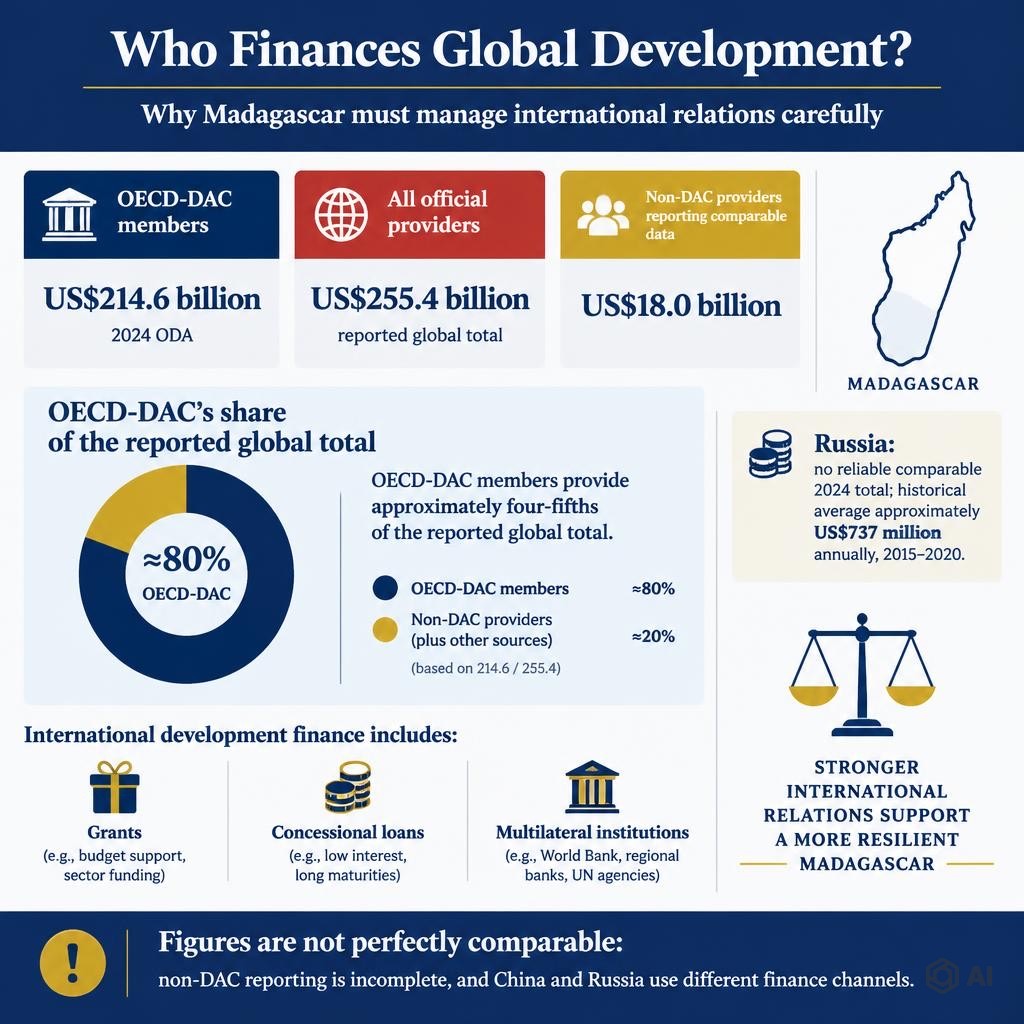
Madagascar has the right to pursue an independent foreign policy. However, independence is easier to defend when a country is financially self-reliant.
Madagascar continues to depend heavily on foreign grants, concessional loans, technical assistance and debt support. This creates an important strategic reality: the country must manage its relationships carefully with the governments and institutions that help finance its development.
The scale of international assistance
Official Development Assistance, or ODA, includes grants and concessional loans provided by governments and international organisations to support development and welfare.
The 2024 global figures illustrate the unequal distribution of development finance:
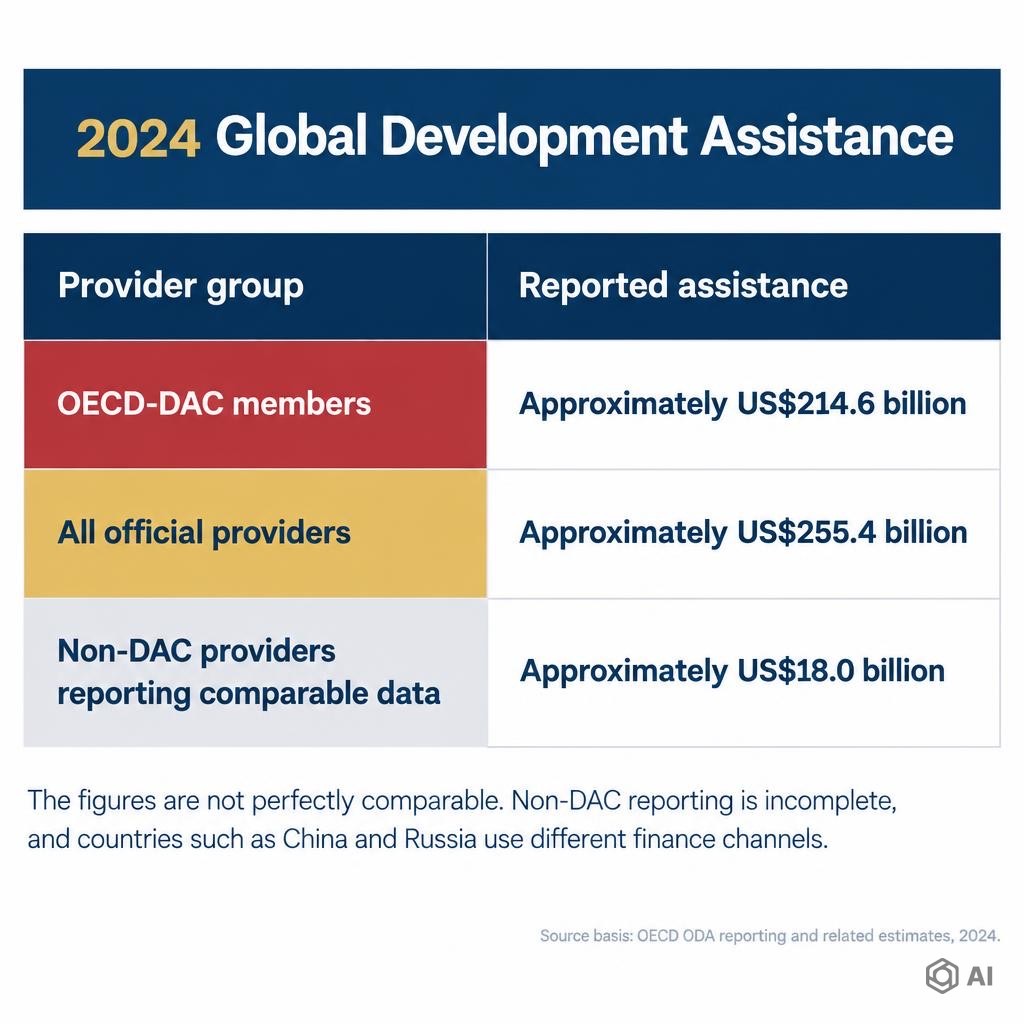
OECD-DAC members therefore accounted for roughly four-fifths of the reported global total.
These figures need to be interpreted carefully. The OECD-DAC figure covers countries such as the United States, Germany, France, the United Kingdom, Japan, Canada, Australia and South Korea. The non-DAC figure is not a complete record of every country outside the DAC system. Some countries do not report their assistance in a comparable way.
Nevertheless, the broad conclusion is clear: the OECD-DAC donor system represents the largest and most systematically measured source of development finance.
Where does Russia fit?
Russia does not appear in the OECD-DAC total because it is not a current DAC reporting donor.
There is no reliable, directly comparable figure for Russia’s total development assistance in 2024. Earlier available data suggested that Russia’s official development assistance averaged approximately US$737 million per year between 2015 and 2020, but this is historical and should not be presented as a current figure.
This is significant. Russia may offer Madagascar political, commercial or security partnerships, but its measurable development assistance has historically been much smaller than the combined contribution of OECD-DAC donors.
China is also outside the OECD-DAC system. Its assistance is often provided through infrastructure finance, state-backed loans, construction projects and trade arrangements rather than conventional grants. This makes direct comparison difficult.
Why this matters to Madagascar
The issue is not whether Madagascar should cooperate with China, Russia or other emerging partners. Diversifying international relationships can be sensible.
The issue is whether alternative partners can replace the full range of support provided through the OECD-DAC and multilateral system.
That support may include:
- Grants for healthcare and education
- Budget support
- Humanitarian assistance
- Debt restructuring
- Infrastructure finance
- Technical expertise
- Agricultural and environmental programmes
- Support from the IMF, World Bank, European Union and African Development Bank
A country may receive an infrastructure loan from one partner while relying on another group of donors to finance health services, teachers’ salaries, agricultural programmes or debt relief.
Aid is not only about money
Foreign assistance also creates relationships.
Donor governments and international institutions may influence the standards expected in areas such as:
- Public financial management
- Anti-corruption measures
- Elections and governance
- Human rights
- Environmental protection
- Transparency and accountability
Madagascar should not surrender its sovereignty. Nor should it accept every external condition without debate. However, it must recognise that diplomatic decisions can have financial consequences.
If relations deteriorate with important donors, funding may be delayed, loans may become more expensive, programmes may be suspended and negotiations over debt may become more difficult.
The cost is ultimately borne by Malagasy citizens.
The case for balanced diplomacy
Madagascar should seek constructive relations with all serious development partners, including OECD-DAC countries, China, Russia, India, Gulf states and regional neighbours.
But diversification should not mean replacing one dependency with another.
The long-term solution is to reduce dependence itself by:
- Improving tax collection
- Reducing corruption
- Making it easier to create and operate businesses
- Increasing domestic production
- Strengthening public institutions
- Managing loans responsibly
- Developing reliable sources of domestic revenue
The more revenue Madagascar raises internally, the greater its freedom to make independent decisions externally.
Conclusion
The 2024 figures show the importance of the OECD-DAC system. Its members provided approximately US$214.6 billion in ODA globally, compared with approximately US$18 billion from non-DAC providers reporting comparable data. Russia’s contribution is not currently available on the same basis and has historically been much smaller.
This does not mean Madagascar must politically agree with every OECD country. It does mean that foreign policy should be guided by financial reality.
Madagascar can and should pursue a balanced international policy. But it must avoid unnecessarily alienating the countries and institutions that provide a large share of the grants, concessional loans and development support on which the country continues to depend.
Diplomatic independence is strongest when it is supported by economic independence.


Comments
Post a Comment