Madagascar’s Maritime Rights: Treaties, Fisheries and Sovereignty
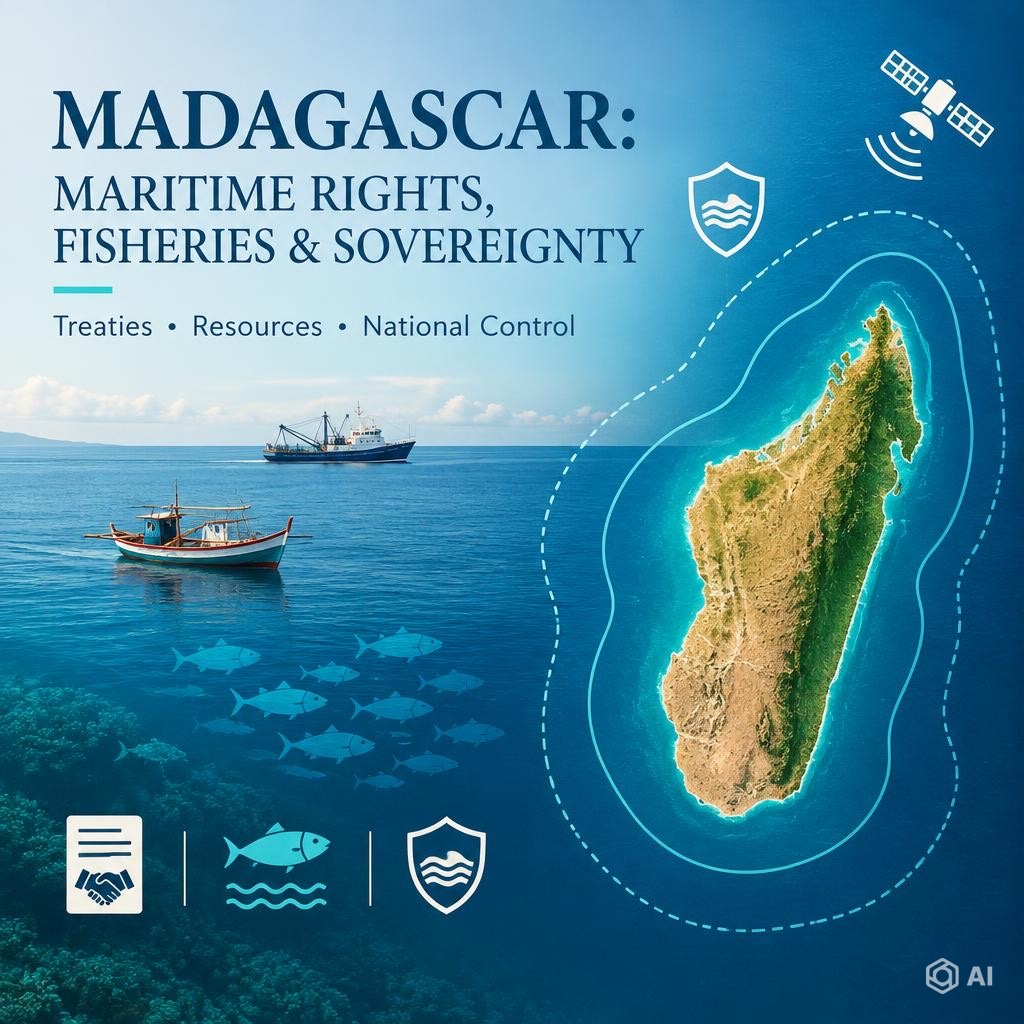
The sea is one of Madagascar’s greatest national assets. It provides food, employment, transport, tourism and access to valuable marine resources. Yet the same waters also expose the country to difficult questions about sovereignty, foreign fishing fleets, international treaties and the balance between immediate economic need and long-term national control.
Madagascar has made important progress in establishing its legal rights over the sea. The challenge now is ensuring that these rights produce lasting benefits for Malagasy citizens.
Establishing Maritime Rights
Madagascar has established a 12-nautical-mile territorial sea and a 200-nautical-mile Exclusive Economic Zone, or EEZ.
Within the territorial sea, Madagascar exercises sovereignty in much the same way it does on land. Within the EEZ, it has sovereign rights to explore, exploit, conserve and manage natural resources, including fish and other marine resources.
Madagascar also ratified the United Nations Convention on the Law of the Sea in 2001. This was an important achievement because UNCLOS provides the international legal framework governing territorial waters, maritime boundaries, natural resources and the responsibilities of coastal states.
Through this framework, Madagascar has secured formal recognition of its authority over a vast maritime area.
Treaties and International Cooperation
Madagascar has also developed maritime relationships through international and regional agreements.
A 2005 agreement with France helped establish maritime boundaries between Madagascar and Réunion. Madagascar also participates in regional fisheries arrangements, including cooperation connected with the Indian Ocean Tuna Commission and the South Indian Ocean Fisheries Agreement.
These agreements are important because fish do not respect national borders. Tuna and other migratory species may pass through the waters of several countries. Cooperation is therefore necessary for conservation, surveillance and the management of shared resources.
However, cooperation must not become a substitute for national control. A strong treaty should help Madagascar manage its resources—not simply give foreign interests access to them.
Foreign Fishing Agreements
Madagascar has the right to regulate foreign fishing vessels operating in its waters. Foreign vessels require an agreement or licence from the Malagasy authorities.
The 2023 Sustainable Fisheries Partnership Agreement with the European Union recognises Madagascar’s sovereignty and rights under UNCLOS. It also links fishing access to scientific advice and the concept of an “allowable surplus”—the amount of fish that can be taken after the needs of sustainable management and local fisheries have been considered.
The agreement includes provisions on monitoring, conservation, control and action against illegal, unreported and unregulated fishing.
On paper, these are significant safeguards. They show that Madagascar has not simply abandoned control of its marine resources. It has created a legal structure through which foreign access can be authorised and regulated.
The Gap Between Legal Rights and Practical Control
The existence of laws and treaties does not automatically guarantee effective sovereignty.
Madagascar still faces serious challenges:
- Monitoring a large maritime zone
- Preventing illegal fishing
- Tracking foreign vessels
- Enforcing licence conditions
- Protecting small-scale fishers
- Ensuring accurate reporting of catches
- Making agreements transparent
- Preventing corruption and abuse of authority
A country may possess strong legal rights but lack the ships, technology, funding or institutional capacity needed to enforce them.
This creates a gap between formal sovereignty and practical sovereignty. Formal sovereignty exists in international law. Practical sovereignty exists when the government can actually see, regulate and control what happens in its waters.
Economic Need and National Interest
Madagascar needs income, investment and international cooperation. Fishing agreements can provide licence payments, technical assistance, scientific cooperation and opportunities for economic development.
The danger arises when short-term revenue becomes more important than long-term national interest.
If too many vessels are licensed, fish stocks may decline. If agreements are not transparent, the public may never know whether Madagascar is receiving a fair return. If fish are exported without local processing, the country may lose opportunities for employment and added value.
The central question should therefore not be simply:
How much money does Madagascar receive from a fishing agreement?
It should also be:
How much value is created for Malagasy workers, communities, businesses and future generations?
The Rights of Local Fishing Communities
Small-scale fishers should be at the centre of maritime policy. For coastal families, the sea is not an abstract economic zone. It is a source of food, income, tradition and survival.
Industrial fishing can create competition for the same resources. If local catches decline, communities may experience falling incomes and increased food insecurity.
National sovereignty must therefore include more than the authority of the state to sign treaties. It must include the rights of Malagasy citizens to benefit from national resources.
A government cannot credibly defend sovereignty while allowing local communities to lose access to the waters on which they depend.
Madagascar’s Achievements—and Its Unfinished Work
Madagascar has achieved several important things:
1. It has established its territorial waters and EEZ.
2. It has ratified UNCLOS.
3. It has modernised parts of its maritime legislation.
4. It has concluded maritime boundary arrangements.
5. It regulates foreign fishing through agreements and licences.
6. It participates in regional fisheries management.
7. It has accepted international standards on monitoring and conservation.
These are meaningful achievements. They give Madagascar a legitimate legal foundation for defending its maritime interests.
But the unfinished work is equally important. Madagascar must convert legal authority into effective administration. It must strengthen surveillance, publish fishing agreements, protect local communities, improve enforcement and ensure that marine resources contribute to national development.
Sovereignty Must Benefit the People
A treaty is not automatically beneficial simply because it is legal. A fishing agreement is not automatically fair simply because it brings revenue. Sovereignty is meaningful only when national control produces public benefit.
Madagascar’s maritime future depends on finding the right balance:
- Cooperation without dependency
- Investment without surrender
- Foreign access without exploitation
- Revenue without depletion
- Development without environmental destruction
The country has already established many of the legal tools it needs. The next question is whether those tools will be used transparently and effectively.
Madagascar has rights over its waters. The real test is whether it can transform those rights into food security, employment, environmental protection and lasting prosperity for its people.


Comments
Post a Comment