Madagascar’s Pension Funds: A Bailout Without Transparency?
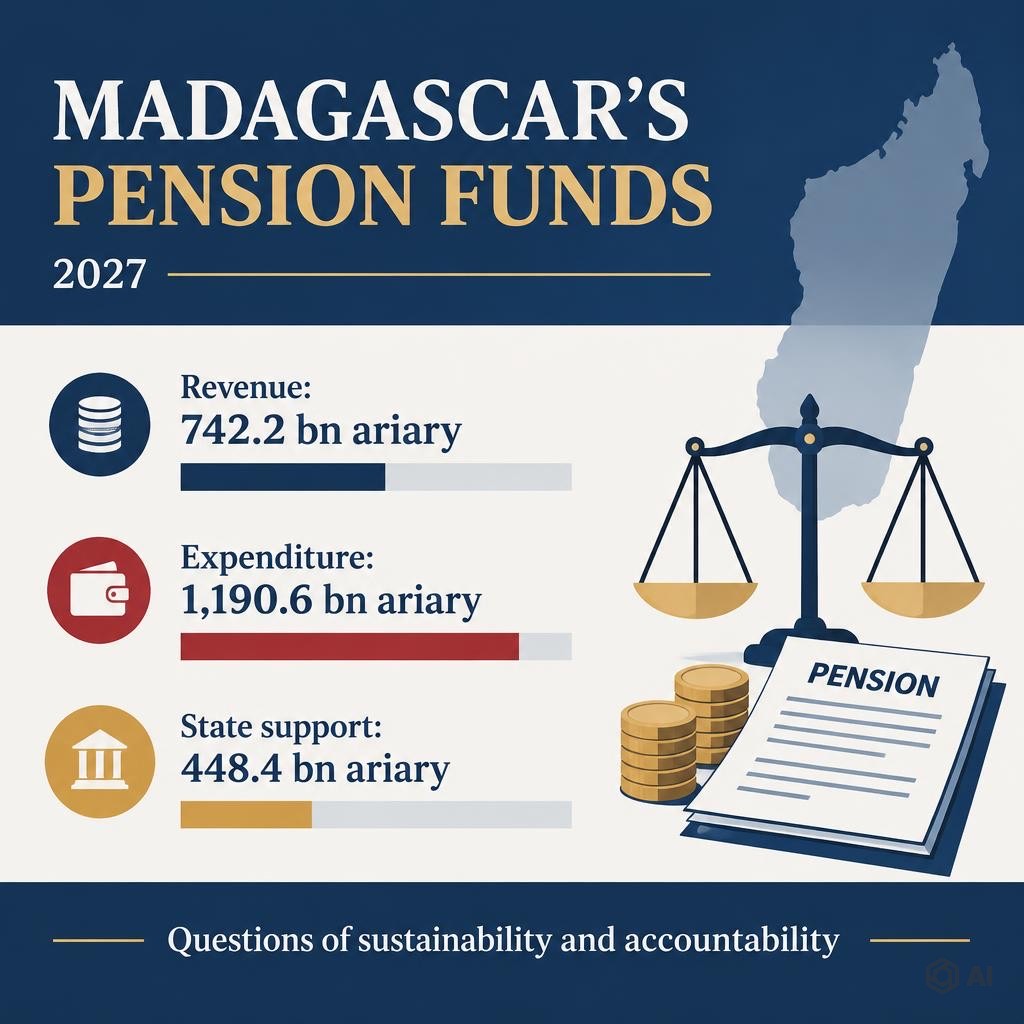
Madagascar’s 2027 initial finance bill reportedly provides for a State contribution of 448.4 billion ariary to support two public pension funds: the Caisse de Retraites Civiles et Militaires (CRCM) and the Caisse de Prévoyance et de Retraites (CPR).
The reported figures are:
- Own revenue: 742.2 billion ariary
- Planned expenditure: 1,190.6 billion ariary
- Financing gap: 448.4 billion ariary
- 2026 financing gap: 459.8 billion ariary
The reduction is welcome, but modest. The more important question is why these funds continue to require such substantial support from the State.
What are these funds?
The CRCM provides pensions for civil servants and military personnel. The CPR serves another category of public-sector employees. Both are ultimately linked to public finances, meaning that persistent deficits become a burden on taxpayers and the national budget.
A State subsidy is not automatically evidence of failure. Pension systems can legitimately require government support when contributions are insufficient, the number of pensioners increases, or past commitments were based on assumptions that no longer apply.
However, public support creates a responsibility to explain clearly how the money is being used and whether the system is sustainable.
Why actuarial review matters
Having worked in the pension environment during my career, I know that an annual financing gap reveals only part of the picture.
Pension liabilities are long-term commitments. They may extend for decades and may not appear fully as conventional government debt. If contributions, reserves and investment income are insufficient to meet promised benefits, the State ultimately carries the risk.
That can increase future deficits, restrict spending on education, healthcare and infrastructure, and transfer the burden to future taxpayers.
An independent actuarial valuation should therefore establish:
- the number of contributors and pensioners;
- the funds’ accumulated and future liabilities;
- contribution and benefit trends;
- arrears and unfunded commitments;
- the assumptions used for life expectancy and salary growth;
- and the likely future burden on the national budget.
The questions that need answers
Is there a recent, independent actuarial valuation of both funds?
Are complete audited financial statements publicly available?
How many contributors are supporting each pensioner?
Why is the CRCM structurally in deficit?
If the CPR is in a stronger financial position, are resources transferred between the funds? If so, under what legal authority and according to what rules?
Who is responsible when audit recommendations are not implemented?
These are not accusations of corruption. They are basic questions of financial governance.
Reform requires measurable results
The government has referred to improved contribution collection, stronger oversight and modernised administration. These may be necessary reforms. Digitising records, verifying beneficiaries and improving payment systems could all strengthen control.
But reform should be measured by published results:
- improved contribution collection;
- fewer unexplained beneficiaries;
- reduced arrears;
- reliable financial statements;
- lower annual subsidies;
- and a clear long-term financing plan.
The issue is not whether Madagascar should support its pensioners. Pensioners are entitled to the benefits they have earned.
The issue is whether citizens are being given enough information to judge the system’s condition and the government’s proposed solution.
A bailout of 448.4 billion ariary may be necessary. But without a current actuarial review, independently audited accounts and transparent reporting, citizens are being asked to finance a system they cannot properly evaluate.
Before more public money is committed, Madagascar should publish the numbers, the assumptions, the audit findings and the timetable for reform.


Comments
Post a Comment