Public Administration Training: Why Russia?
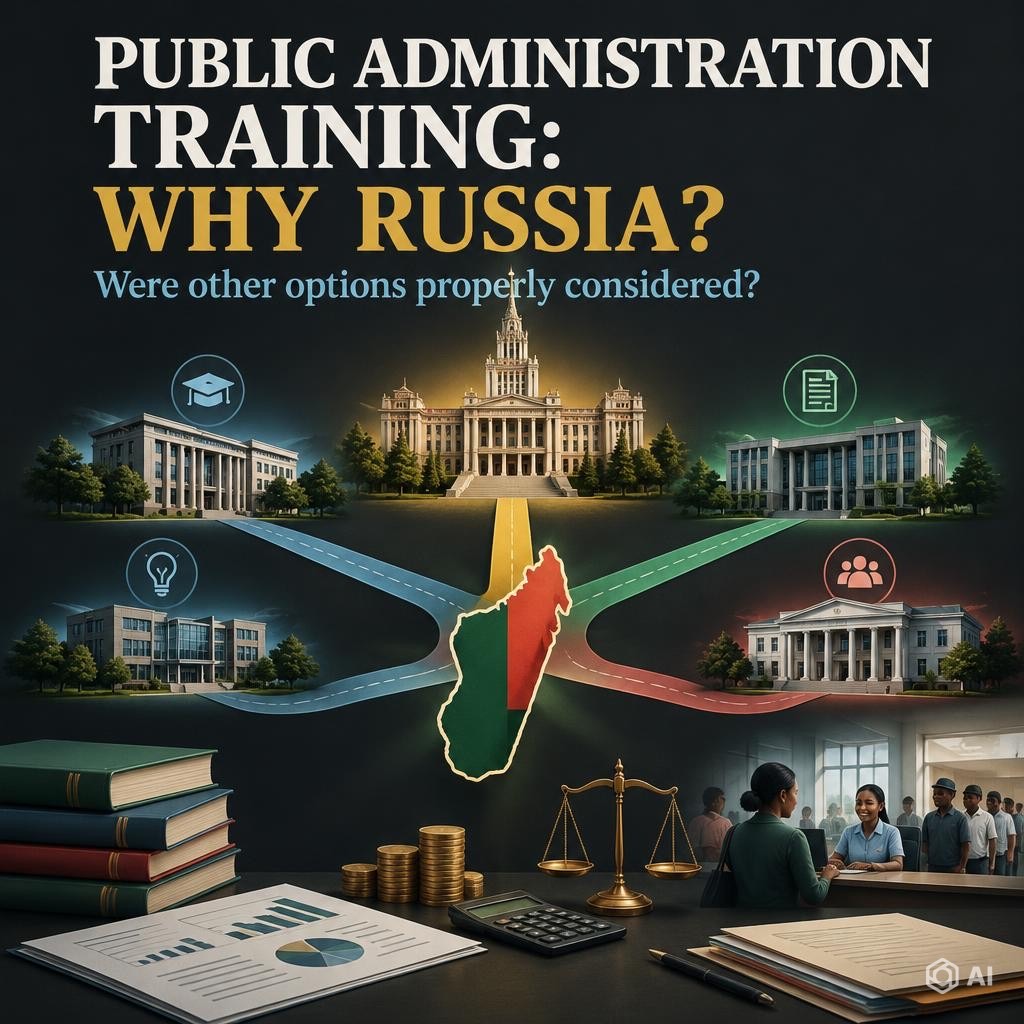
The decision to send Malagasy officials to Russia for training in public administration raises a further question: what alternatives were considered, and why was Russia selected?
Public administration is a well-established academic and professional field. Universities and training institutions around the world offer programmes covering:
- public policy and strategic planning;
- administrative and constitutional law;
- public finance, taxation and budgeting;
- procurement, auditing and financial control;
- human-resource management;
- project management and public-sector reform;
- decentralisation and local government;
- digital government and data management;
- ethics, anti-corruption and accountability;
- leadership, negotiation and crisis management;
- statistics, economics and policy evaluation.
Such courses are available across Africa, Europe, North America and Asia. Many are designed specifically for developing countries and fragile states. Some are delivered through universities, while others are provided by public-policy schools, civil-service colleges and international development institutions.
Language is also unlikely to be an insurmountable obstacle. Programmes are commonly available in English or French, with others offered in Spanish, Portuguese, Arabic, Chinese or Russian. Some institutions provide translation, language preparation or bilingual teaching.
This does not mean that Russia has nothing to offer. Russia has considerable experience in central administration, territorial management, public-sector organisation and the governance of a large and complex state. Russian officials and academics may certainly provide useful lessons.
However, it would be difficult to argue that Russia is automatically the leading international centre of intellectual thought in public administration. If the objective is to strengthen Madagascar’s institutions, there are many possible partners with strong reputations in public policy, development economics, democratic governance, anti-corruption, decentralisation and public-service reform.
The question is therefore not whether Russian training can be useful. It is:
Were other options properly considered—and, if so, why was Russia chosen?
Was the decision based on academic quality, cost, language, political alignment, diplomatic interests or the nature of the model being promoted?
That distinction matters. Madagascar should seek the best knowledge available, not simply the most politically convenient partnership.
Training Malagasy officials abroad may be valuable. But the ultimate test will be whether they return able to collect revenue fairly, manage public funds transparently, deliver reliable services and accept accountability.
The country does not merely need officials who know how to administer a state. It needs officials who understand that the state exists to serve its citizens.


Comments
Post a Comment