The Pyramid of Accountability: Part 3 Part Three: Communities and Civil Society
Part Three: Communities and Civil Society
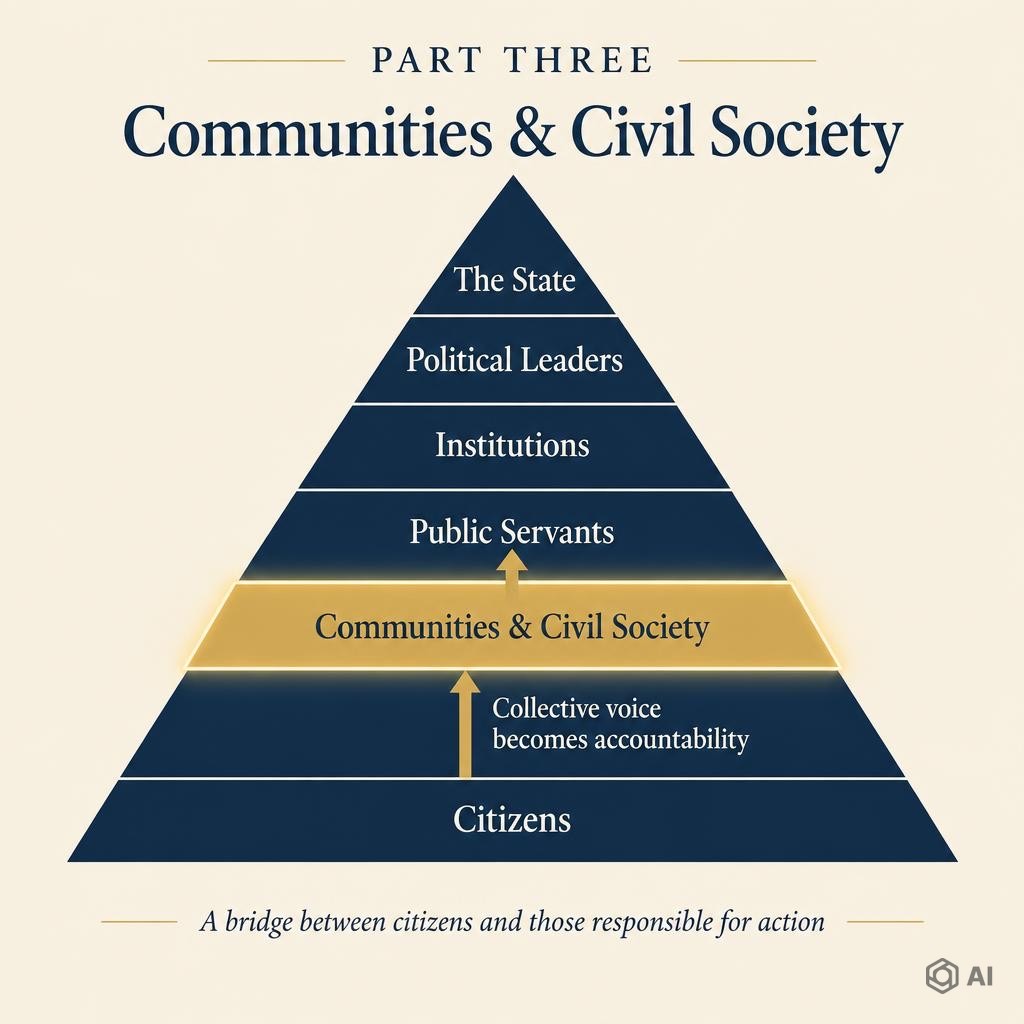
In the Pyramid of Accountability, communities and civil society form the layer immediately above citizens and below public servants. This position is important. Communities are not the ultimate source of power, nor are they merely passive recipients of government decisions. They are the link through which citizens can combine their voices and move responsibility upwards.
Individual citizens may experience corruption, poor public services, insecurity or abuse, but one person acting alone can easily be ignored. Communities make these concerns visible. Through neighbourhood groups, churches, schools, associations, journalists and civil society organisations, individual experiences can become collective demands.
Their role is therefore to:
- identify problems affecting citizens;
- gather information and evidence;
- represent community concerns;
- monitor public services;
- challenge abuse and corruption;
- protect vulnerable people; and
- demand answers from public servants and institutions.
This makes communities an essential accountability mechanism. They translate everyday experiences into pressure that public servants, institutions, political leaders and the State cannot easily dismiss.
However, communities and civil society are not automatically democratic or accountable. Local leaders, traditional authorities, religious organisations and influential families may also discourage criticism or protect powerful individuals. Social pressure can silence citizens just as effectively as formal censorship. A community may defend its members, but it may also demand conformity and punish dissent.
The question is therefore not simply whether communities are active. The more important question is: whom do they serve?
A strong civil society serves citizens. It creates safe spaces for discussion, supports people who speak out and ensures that local concerns reach the institutions responsible for addressing them. A weak or captured civil society may instead reproduce the same control it is supposed to challenge.
Communities also have a responsibility to act honestly. Accountability must not mean accusing others while refusing to examine one’s own conduct. Civil society organisations should be transparent about their funding, leadership and decisions. Community representatives should report back to the people they claim to represent. Public criticism should be based on evidence rather than rumour, political rivalry or personal hostility.
In this pyramid, responsibility must move upwards. Citizens raise concerns through communities and civil society. These concerns are then directed towards public servants, institutions, political leaders and ultimately the State. Each layer has a duty to respond to the layer below it.
When this upward movement works, citizens are not isolated. Their experiences become collective knowledge, collective action and ultimately public accountability.
When it fails, communities become a barrier rather than a bridge. Problems remain local, citizens lose confidence and those at the top are protected from scrutiny.
Communities and civil society are therefore the foundation of organised accountability. They give citizens the strength to be heard—but they must also ensure that their own power remains open, inclusive and answerable to the people they represent.


Comments
Post a Comment