The Pyramid of Accountability: Part Four: Public Servants — The Face of the State
Part 4: Public Servants — The Face of the State
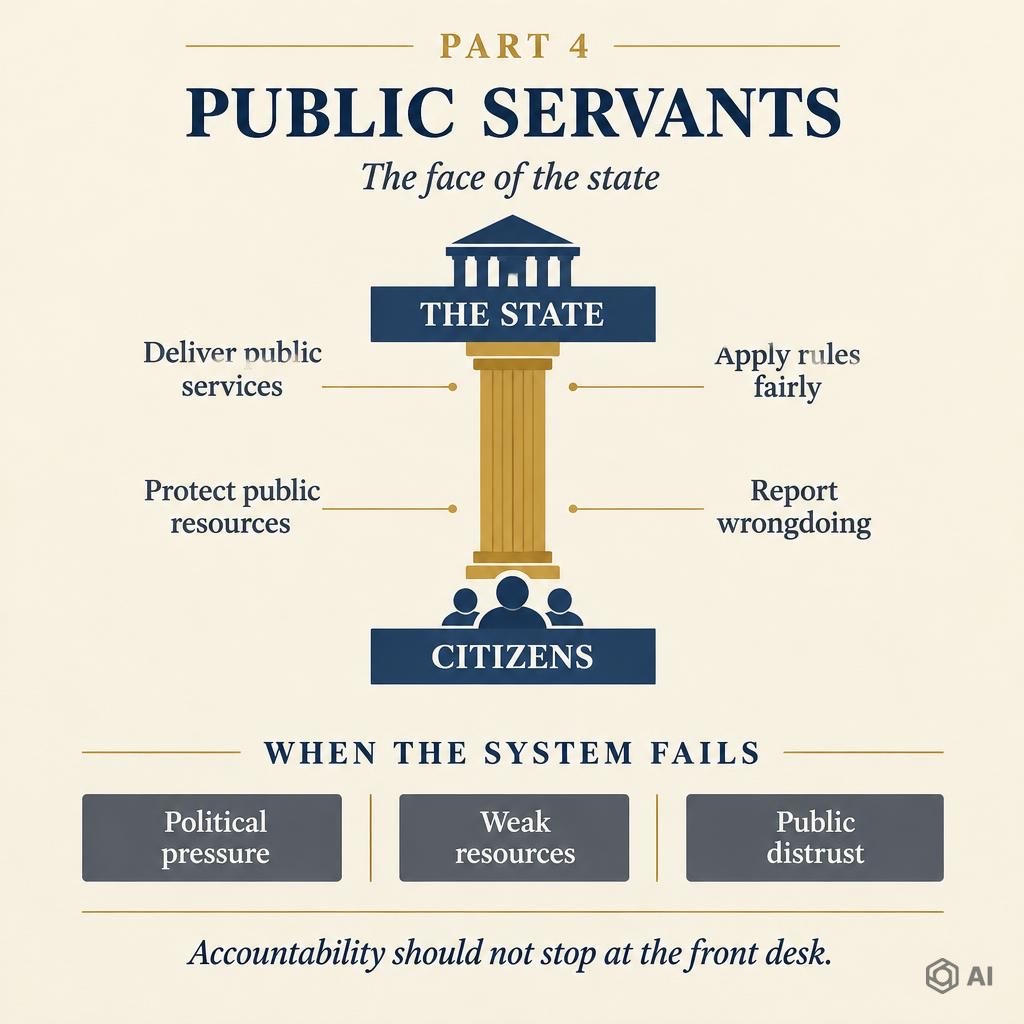
In the Pyramid of Accountability, public servants occupy a central position. They are the people through whom government policies become visible in the daily lives of citizens.
Teachers, nurses, police officers, civil servants, local administrators and municipal employees may not make national decisions, but they implement them. They process documents, deliver services, manage public resources and interact directly with the public. For many citizens, the public servant is the only face of the state they will ever encounter.
In a properly functioning system
In a properly functioning system, public servants serve the public interest—not an individual politician, political party or personal network. They should apply laws fairly, deliver services efficiently, manage public resources honestly and treat citizens with dignity.
Their responsibility is not simply to obey instructions. They must also ensure that government decisions are implemented lawfully and effectively. A public servant should be able to distinguish between a legitimate political decision and an improper order intended to benefit a particular individual or group.
Public servants must also be accountable. They should resist bribery and favouritism, protect public resources, report wrongdoing and accept responsibility for their own conduct.
However, accountability must work in both directions. Public servants need regular salaries, adequate staffing, training, equipment, clear procedures and protection from inappropriate political interference.
A teacher cannot educate effectively without being paid or supplied with basic materials. A nurse cannot provide reliable care without medicines and equipment. A police officer cannot protect the public if the chain of command is corrupt or dysfunctional.
Holding public servants responsible while denying them the resources necessary to perform their duties is not accountability. It is scapegoating.
When the system is not functioning
When the system is not functioning, public servants are no longer supported by clear rules, effective institutions or accountable leadership. They may be expected to deliver services without adequate funding, equipment or staff, while those responsible for these failures avoid scrutiny.
Public service can then become politicised. Appointments may depend on loyalty rather than competence. Promotion may be influenced by personal connections instead of performance. Public servants may be pressured to favour certain individuals, overlook abuses or follow instructions that serve private interests rather than the public good.
Citizens experience the consequences directly. Services become slow or unreliable. Rules are applied inconsistently. Public resources are diverted. In some cases, citizens may be expected to make unofficial payments simply to receive services to which they are already entitled.
This creates a dangerous cycle. Citizens lose trust in public institutions, while public servants become defensive, disengaged or dependent on political protection. Some may withdraw from their responsibilities; others may adapt to the system through bribery, favouritism or silence.
Individual misconduct must not be excused. Public servants who abuse their authority or participate in corruption should be held accountable. But it is equally important to recognise that individual misconduct often flourishes within a wider system of weak oversight, political interference and absent consequences.
When public servants are used as scapegoats, responsibility remains hidden. Officials who control budgets, appointments and institutions can avoid scrutiny, while the person at the public counter carries the blame.
A failed system therefore produces two injustices. Citizens are denied the services to which they are entitled, while honest public servants are left without the protection and support needed to serve properly.
The public servant is both an agent of the state and a servant of the citizen. Their duty is to connect the two—not to place themselves above the public, but to ensure that government authority is exercised in the public interest.
Accountability should not stop at the front desk. It must continue upwards, to the institutions and leaders responsible for the conditions under which public services are delivered.


Comments
Post a Comment