The Pyramid of Accountability: Part 5 Part Five :Institutions: the bridge between citizens and the state
Part Five : Institutions: the bridge between citizens and the state
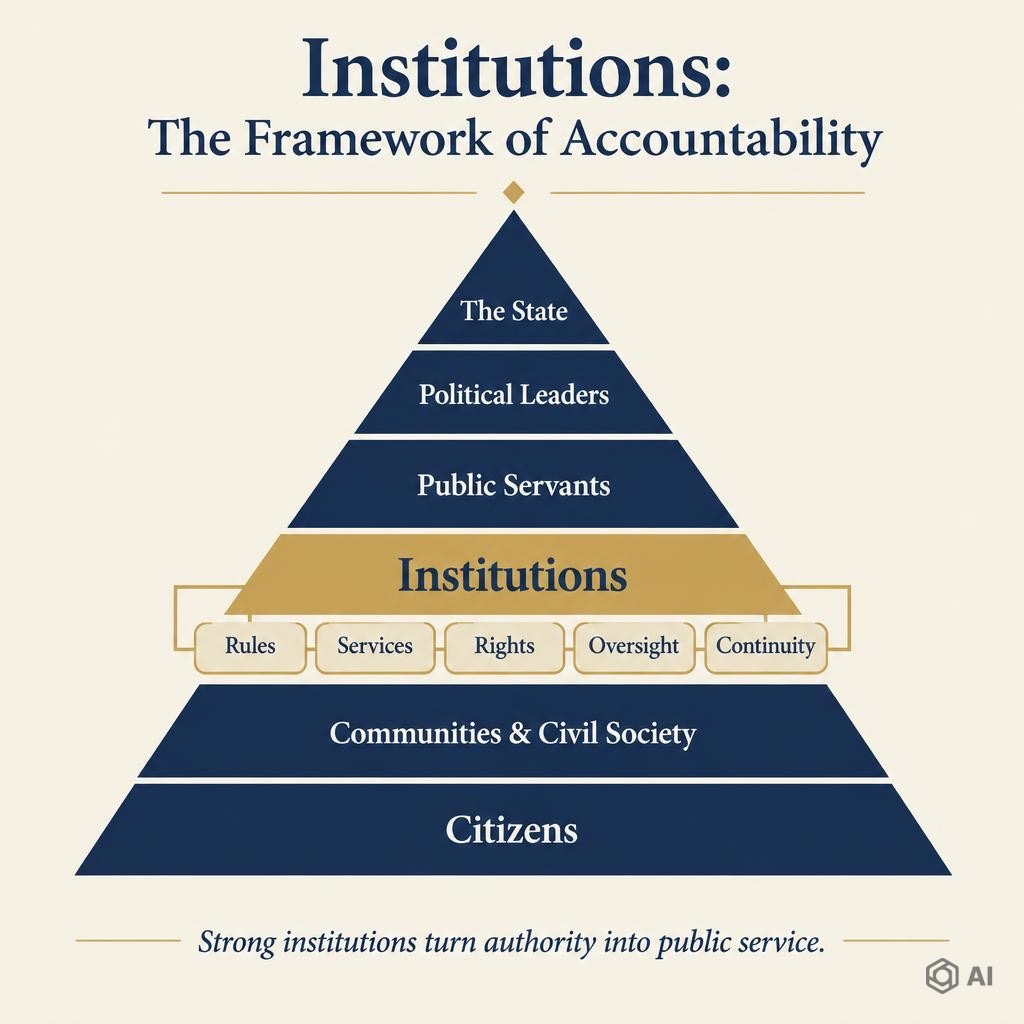
Institutions are the structures through which a society organizes power, makes decisions and delivers public services. They include government departments, courts, schools, hospitals, regulatory bodies, local authorities and oversight organizations. They also include the rules, procedures and professional standards that guide how these bodies operate.
Institutions provide the link between citizens and the state. Citizens express their needs through communities and civil society. Public servants convert policies into services. Political leaders establish priorities. Institutions connect these levels and determine whether responsibility is exercised fairly and effectively.
Without strong institutions, society becomes dependent on individuals. A capable leader may produce temporary improvements, but those improvements may disappear when that leader leaves office. Strong institutions create continuity. They ensure that public responsibilities are carried out according to rules rather than personal preference.
The purpose of institutions
The first purpose of institutions is to create order. They establish procedures for making decisions, resolving disputes and coordinating the activities of society.
Their second purpose is to limit power. Institutions should prevent political leaders, officials or influential individuals from acting without restraint. Courts, legislatures, audit bodies and the media all contribute to this process by asking who made a decision, under what authority and with what consequences.
Institutions also protect rights, deliver public services and manage public resources. They give citizens access to education, healthcare, justice, security and infrastructure. They should ensure that public money is collected and spent lawfully, transparently and for the benefit of the population.
Finally, institutions provide a means of correction. No institution will make every decision correctly. The test of a healthy institution is whether mistakes can be challenged, investigated and corrected without fear or favour.
Optimal and suboptimal institutions
Optimal institutions are based on clear rules that apply equally to everyone. They recruit people according to competence, maintain professional standards and accept scrutiny. Their authority comes from law, but their legitimacy comes from serving the public interest.
Suboptimal institutions may still appear to function. They may have official titles, offices, procedures and regulations. However, their real operation is distorted by political interference, corruption, patronage or personal loyalty.
In a suboptimal institution, rules may be applied selectively. Appointments may depend more on connections than ability. Public resources may be used to reward supporters. Decisions may be made secretly, while responsibility is passed downwards and power remains concentrated at the top.
The difference is therefore not simply whether an institution exists. The important question is whether it performs its intended purpose.
An institution is optimal when it converts authority into public service. It becomes suboptimal when it converts public authority into private advantage.
How institutions should be organized
Healthy institutions require clearly defined responsibilities. Political leaders should establish policy and priorities, while professional public servants should implement those decisions according to law.
There must also be separation between decision-making and oversight. An institution should not be the sole judge of its own performance. Independent bodies must be able to examine finances, investigate wrongdoing and receive complaints.
Good institutions also require:
- clear lines of authority;
- transparent procedures;
- competent personnel;
- adequate resources;
- reliable records;
- measurable responsibilities;
- independent oversight; and
- consequences for misconduct.
Accountability must operate in both directions. Public servants should be accountable to institutions, political leaders should be accountable to citizens and the state itself should remain accountable to the people from whom it derives its authority.
This is why institutions occupy such an important place in the Pyramid of Accountability. They are the framework that connects every level of society. When they are strong, responsibility can move upwards and problems can be addressed before they become crises. When they are weak, accountability stops at the level of the individual and the entire system becomes vulnerable to abuse.
Institutions do not eliminate human weakness. Their purpose is to ensure that human weakness does not become a permanent feature of public life.


Comments
Post a Comment