Treaties Without Compliance: Madagascar’s Familiar Story
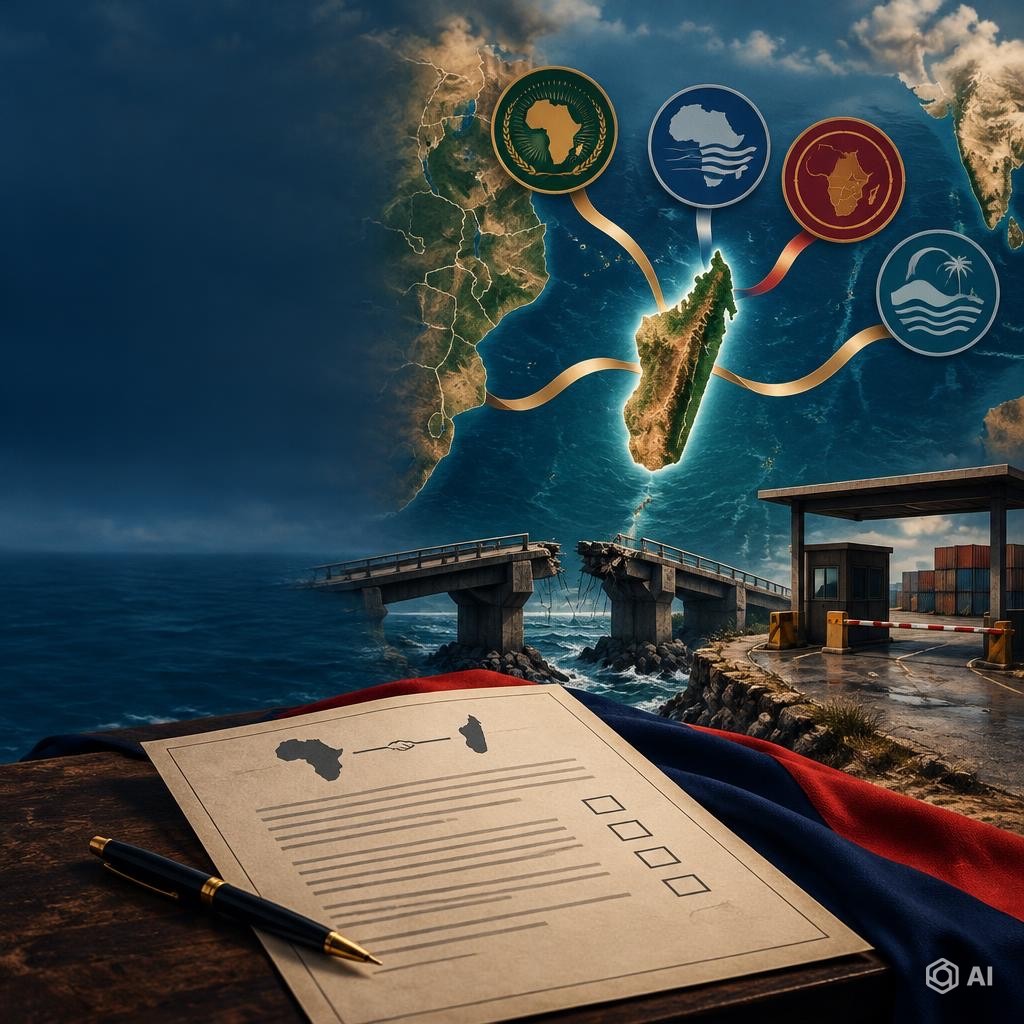
Madagascar is a member of the African Union, COMESA, SADC and the Indian Ocean Commission. It has signed regional treaties, accepted obligations and repeatedly declared its commitment to African integration.
On paper, the country is connected to a considerable regional market. In practice, however, the familiar story returns: Madagascar signs the treaty, makes the commitment and then struggles to meet the requirements.
This is not simply a question of political goodwill. Regional agreements impose practical obligations. Governments must align laws, simplify customs procedures, apply rules of origin, remove unnecessary barriers and ensure that businesses can actually use the promised preferences. They must also ratify supporting protocols and implement reforms within agreed timetables.
Madagascar has often fallen short.
Under SADC, some related protocols remain incomplete or unratified. Under the COMESA framework, businesses continue to face administrative obstacles, customs difficulties and uncertainty over preferential treatment. The Tripartite Free Trade Area linking COMESA, the East African Community and SADC has also failed to become a fully effective instrument for Madagascar because ratification and implementation remain incomplete.
The result is a gap between membership and participation.
Madagascar can claim access to regional markets, but access on paper is not the same as commercial access. A Malagasy exporter must still prove that goods meet rules of origin, satisfy technical and sanitary standards, complete the correct documentation and move products through a border system that can be slow, expensive and unpredictable.
For large companies, these obstacles may be manageable. For small Malagasy businesses, they can make regional exports uneconomic.
This helps explain why Madagascar’s regional trade remains limited. Its membership of the Indian Ocean Commission has not produced the level of commercial integration that geography might suggest. Trade with neighbouring island economies remains relatively small, and Madagascar continues to run a deficit with the group.
COMESA has produced some growth in Malagasy exports, but imports have also increased significantly. That is not necessarily a failure of regional integration. It does, however, demonstrate a deeper weakness: Madagascar is participating in markets without producing enough competitive goods to benefit fully from them.
The country therefore risks becoming a consumer of regional products rather than a successful regional supplier.
The African Continental Free Trade Area offers another opportunity. Madagascar has moved towards participation, but the AfCFTA will not solve the country’s problems automatically. A treaty cannot manufacture goods, repair roads, modernise customs or eliminate corruption. It cannot compensate for unreliable electricity, weak logistics, limited industrial production or the high cost of doing business.
Treaties create opportunities. Compliance converts those opportunities into results.
This is where Madagascar’s record is disappointing. The country frequently presents international agreements as evidence of progress, but pays less attention to the less visible work required afterwards. Signing ceremonies attract attention. Implementation rarely does.
The pattern is familiar across public administration:
1. A commitment is announced.
2. A treaty or protocol is signed.
3. Ratification is delayed or incomplete.
4. Domestic institutions fail to adapt.
5. Businesses encounter barriers.
6. The government points to membership as proof of success.
This is not genuine integration. It is treaty participation without treaty performance.
The consequences extend beyond trade. Failure to honour regional obligations damages Madagascar’s credibility. Partners become cautious. Investors question whether other commitments will be implemented. Businesses lose confidence in official promises. Citizens see another example of a state that announces reform but struggles to deliver it.
Madagascar does not lack agreements. It lacks consistent execution.
The government should therefore publish a clear implementation schedule for each major regional commitment. It should identify which obligations have been completed, which remain outstanding and who is responsible for delivering them. Parliament, business organisations and civil society should be able to monitor progress.
There should also be a single, coherent national strategy for managing overlapping commitments under COMESA, SADC and the AfCFTA. Businesses should not have to navigate a maze of conflicting rules and procedures simply because government departments have failed to coordinate.
Regional integration can help Madagascar diversify its economy, expand exports and attract investment. But that will happen only when the country moves from symbolic membership to practical compliance.
The uncomfortable truth is that Madagascar’s problem is not a shortage of treaties. It is the repeated failure to meet the obligations that treaties create.
Until that changes, regional integration will remain another promising reform trapped between signature and implementation.


Comments
Post a Comment