Women and Children in Madagascar: Commitments on Paper, Protection in Practice
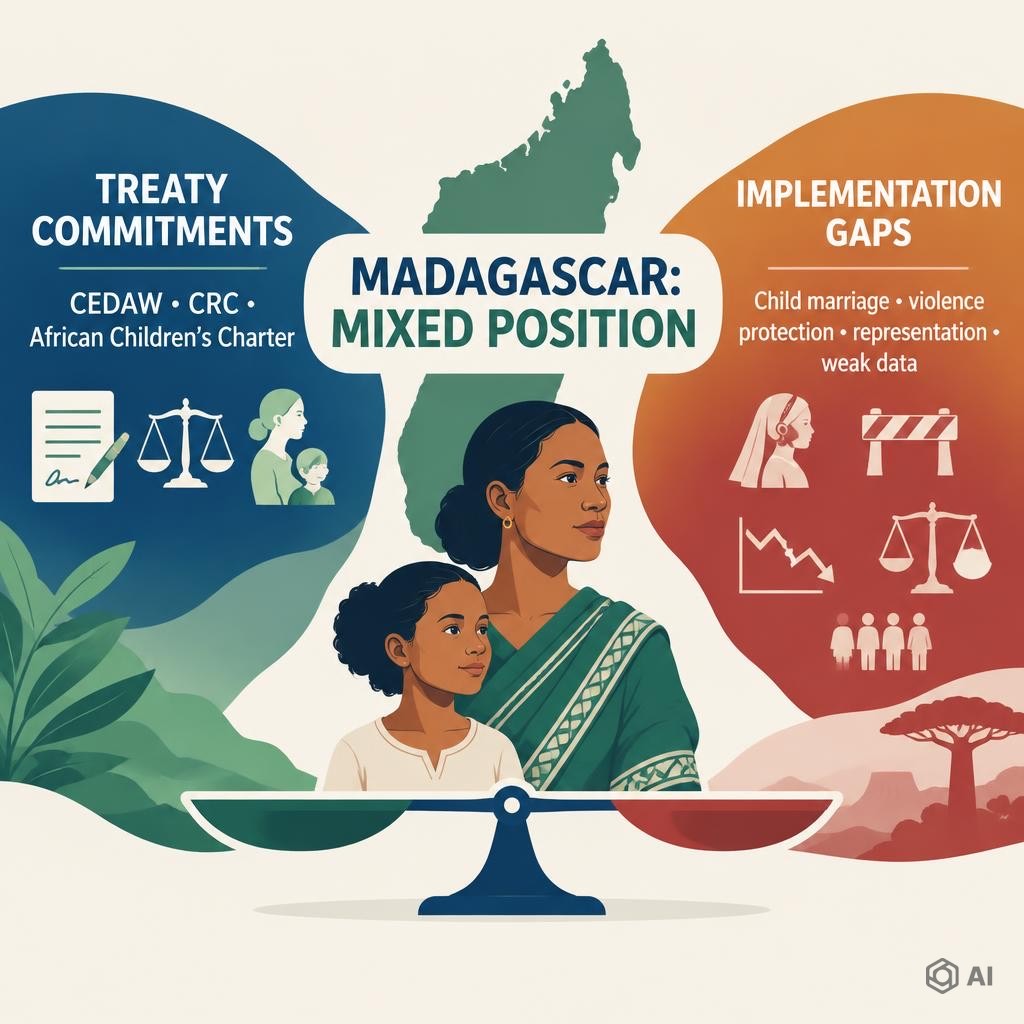
Madagascar has signed up to many of the major international and regional agreements protecting women and children. The country has accepted important legal responsibilities. The more difficult question is whether those commitments are being translated into protection, equality and opportunity in everyday life.
The answer is mixed.
What Madagascar has signed up to
Madagascar ratified the Convention on the Elimination of All Forms of Discrimination against Women (CEDAW) in 1989. It also ratified the Convention on the Rights of the Child (CRC) in 1991.
In relation to children, Madagascar has ratified the Optional Protocols concerning:
- Children in armed conflict
- The sale of children, child prostitution and child pornography
Madagascar has also ratified the African Charter on the Rights and Welfare of the Child, as well as key International Labour Organization conventions concerning the minimum age of employment and the worst forms of child labour.
These commitments are significant. They require Madagascar to prevent discrimination, protect children from exploitation and violence, improve access to education and healthcare, and ensure that women and children can claim their rights.
However, several gaps remain. Madagascar has signed but not ratified the Optional Protocols to CEDAW and the CRC that would allow individuals to bring complaints to the relevant international committees.
Ratification does not solve every problem, but failure to ratify complaint mechanisms limits the ways in which victims can seek international redress.
How is Madagascar scoring?
Madagascar’s formal commitment is stronger than its practical performance.
Women remain significantly underrepresented in political decision-making. Women held only around 18.5% of parliamentary seats in 2024. This matters because political representation affects which issues receive attention, funding and enforcement.
Child marriage remains a serious concern. Around 38.8% of women aged 20–24 had been married or in a union before the age of 18. This restricts girls’ education, economic independence and personal autonomy.
The burden of unpaid care work is also highly unequal. Women and girls aged five and above spent approximately 14.6% of their time on unpaid domestic and care work, compared with 2.8% for men.
This difference is not simply a private family matter. It affects women’s ability to work, study, participate in public life and build financial independence.
Progress in reproductive healthcare is also incomplete. In 2020, modern contraceptive needs were satisfied for approximately 65.6% of women aged 15–49. That represents progress, but it also means that a substantial number of women still lacked access to the services they needed.
The legal framework itself is incomplete. Only around 55.6% of the measured legal frameworks relating to gender equality were in place, particularly in the area of violence against women.
Children’s rights: laws without consistent enforcement
The UN Committee on the Rights of the Child has recognised several positive developments in Madagascar. These include the establishment of child-protection institutions, legislation addressing trafficking and gender-based violence, increased budgets for education and health, and a national social-protection strategy.
But the Committee also identified serious weaknesses.
Existing legislation is not consistently implemented. Laws protecting children do not have their full effect when there are insufficient resources, weak institutions, limited data or poor enforcement outside the main urban centres.
The Committee called for:
- Better implementation of child-rights legislation
- Revision of the national law on children’s rights and protection
- Improved birth registration
- Stronger protection against exploitation and trafficking
- Better data on vulnerable children
- More effective implementation across the entire country
These are practical problems, not merely technical ones. A child without a birth certificate may struggle to access education, healthcare or legal protection. A child exposed to exploitation may have no effective authority to turn to. A law against abuse is of limited value if victims cannot report it safely and offenders are not held accountable.
The reporting problem
International treaties create an additional responsibility: governments must report regularly on their progress.
Madagascar’s eighth report under CEDAW was already overdue by 2019. Delayed reporting does not necessarily prove that nothing is being done, but it weakens transparency and makes it harder to assess progress.
Reliable data are also missing in many areas. Only around 37.7% of gender-related Sustainable Development Goal indicators were available in the latest assessment. Significant gaps remain concerning violence, employment, harassment, access to technology, land ownership and control of assets.
What is not measured is difficult to challenge. Without reliable information, government agencies, civil-society organisations and donors cannot easily identify where protection is failing or whether policies are working.
The central weakness: implementation
Madagascar has not ignored women’s and children’s rights. It has ratified important treaties, established legislation and accepted international recommendations.
The problem is the distance between commitment and delivery.
Women continue to face unequal political representation, unequal care responsibilities, early marriage and gaps in protection from violence. Children remain vulnerable to exploitation, weak birth registration, inadequate services and inconsistent enforcement of the law.
This suggests that Madagascar’s main weakness is not the absence of international commitments. It is the limited capacity to convert those commitments into everyday protection.
Overall assessment
Madagascar’s score is therefore mixed:
- Treaty commitment: relatively strong
- Legal framework: partial and incomplete
- Political representation: weak
- Protection from violence and exploitation: uneven
- Child protection: inconsistent
- Data and reporting: inadequate
- Implementation: the principal weakness
Madagascar has signed up to the principles of equality, protection and dignity. The next step is to make those principles real for women and children in every region of the country—not only in legislation, policy documents and international reports.
The measure of commitment is ultimately not what a government signs. It is what women and children experience.


Comments
Post a Comment